About my writing
Throughout my adult life I've written things and occasionally put them online. At the turn of the century I wrote reviews for Broken Pencil magazine (2001–2003), the Instant Coffee email newsletter (2001–2004) and my own Goodreads.ca email newsletter (2004–2009). In 2005 I was part of the inaugural team at BlogTo. During this period I also maintained a blog (2001–2015). After 2015 I tried Medium and since 2021 I've lightly used Substack. In 2026 I restored the blog, and continue to use this page to curate my writing.
The Intelligence of Others Oct 2026
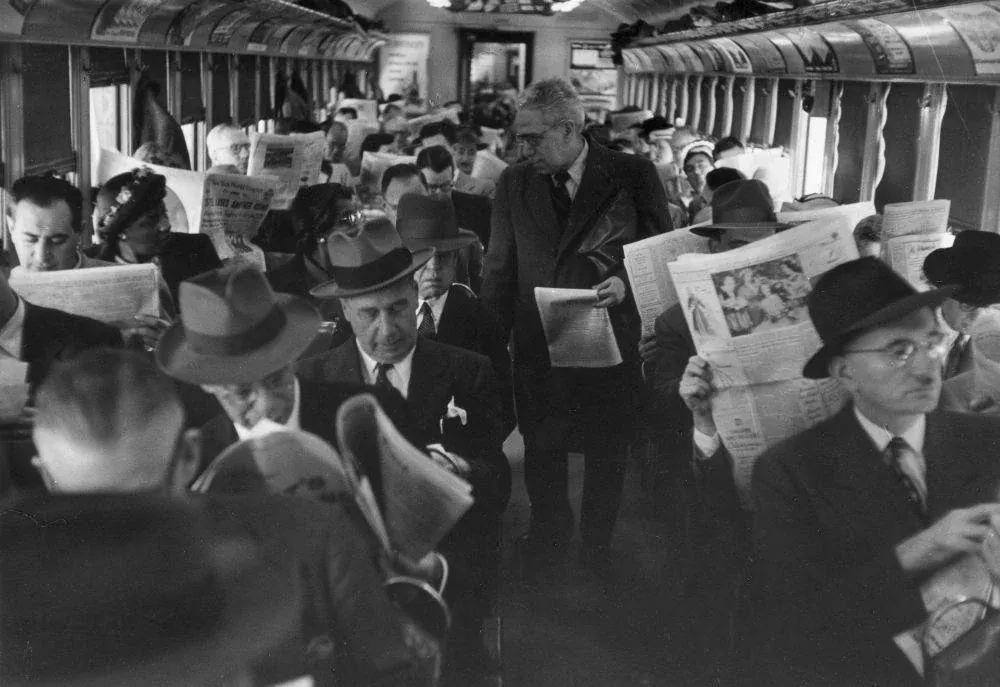
The Intelligence of Others (Oct 2026)
What if artificial intelligence is less alien to human experience than we imagine? Drawing on the histories of art, technology, and humanity’s relationships with other intelligences, this essay explores how AI challenges our ideas of creativity and achievement. From prehistoric wolves to photography and the religious concept of Logos, it suggests that AI may represent a return to an ancient human relationship with intelligence beyond ourselves.
Substack
On Being A Time Travel Artist Sep 2026
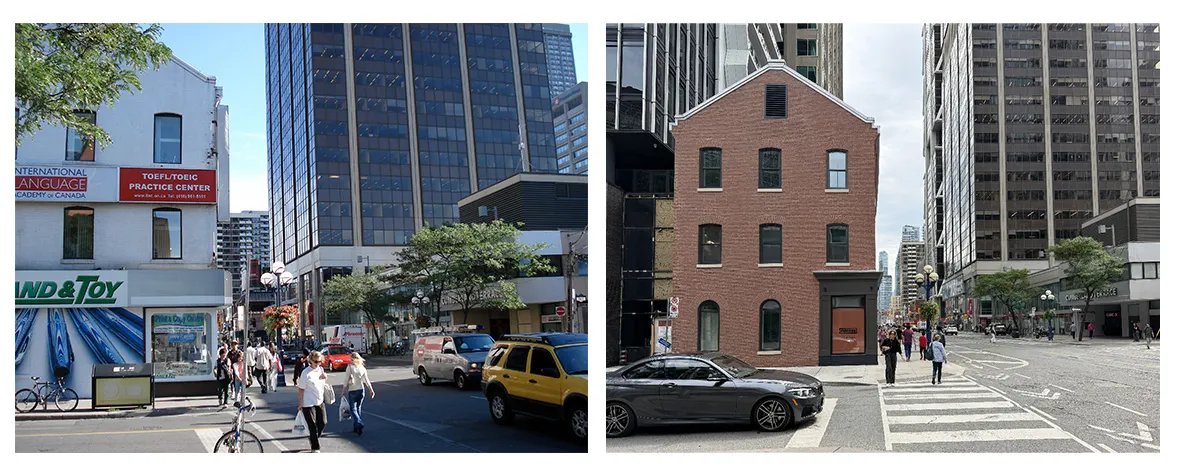
On Being A Time Travel Artist (Sep 2026)
What does it mean to be a time travel artist when actual time travel is impossible? Through photography, science fiction, and the rephotographing of Toronto streets decades apart, this essay explores how art preserves the past and addresses the future. Reflecting on aging, memory, and imagined futures, it suggests that we are all time travellers, and that art makes our vanished worlds legible to generations not yet born.
Substack
Collections of Care Aug 2026
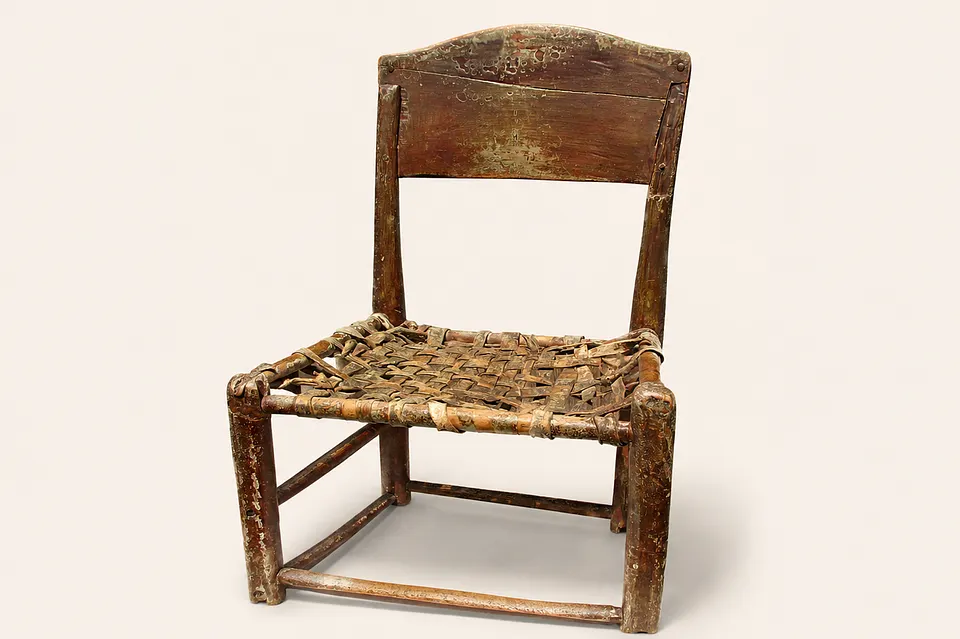
Collections of Care (Aug 2026)
What happens to a civilization when people stop taking care of the things they inherit? Moving between personal memories, art galleries, aging, and the everyday frustrations of contemporary Toronto, this essay explores how care gives meaning and value to the world around us. From museum collections to neglected public spaces, it considers the difference between preservation and hoarding, appearance and substance, and asks what we owe to future generations. Ultimately, it argues that civilization depends less on grand achievements than on the ordinary practice of tending to what matters.
Substack
OK Boomer Mar 2026
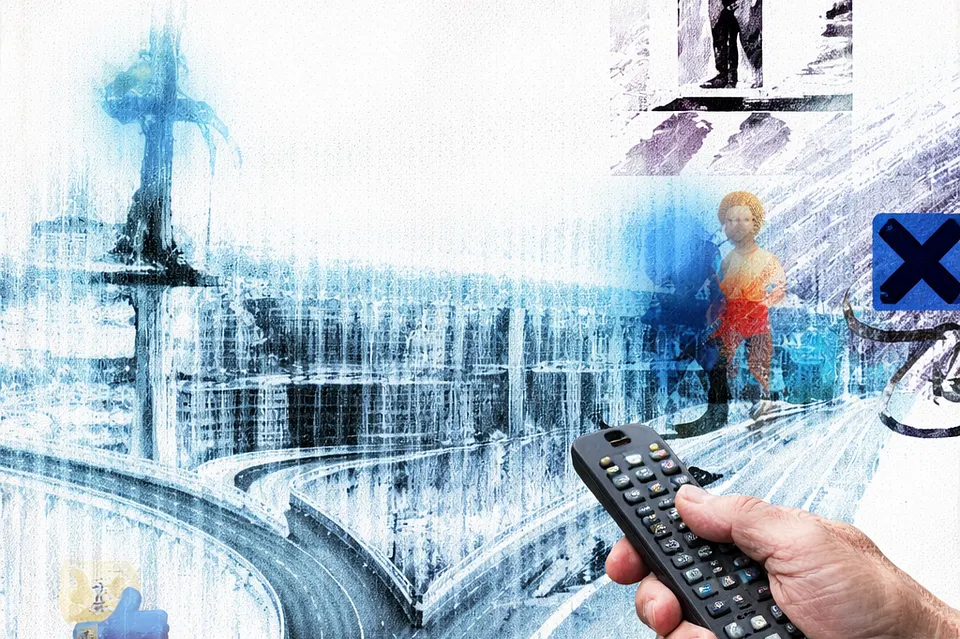
OK Boomer (Mar 2026)
What if artificial intelligence produces a new Baby Boom? Drawing parallels between the postwar expansion of material abundance and the emerging AI revolution, this essay explores how technological progress might transform population growth, employment, and economic opportunity. From the imagined post-scarcity worlds of Star Trek and The Expanse to contemporary political cruelty toward the poor, it argues that abundance alone cannot guarantee prosperity. The question is whether we will share the wealth created by intelligent machines or condemn millions to lives without meaningful opportunity.
Substack
Understanding Heidegger Mar 2026
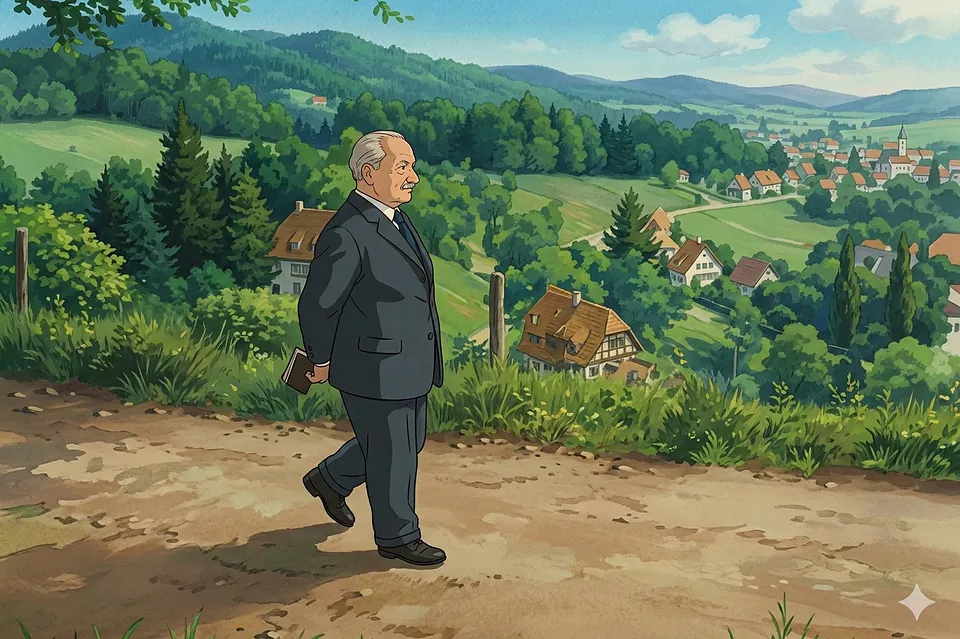
Understanding Heidegger (Mar 2026)
After thirty years of struggling with Martin Heidegger’s philosophy, a new understanding emerges through his distinction between Enframing and Dwelling. Drawing on technology, contemporary culture, Studio Ghibli, and solarpunk visions of the future, this essay explores how our obsession with efficiency and optimization has obscured the human need for beauty, community, and care. Ultimately, Heidegger’s philosophy offers a way to rediscover meaning in everyday activities, suggesting that cooking, cleaning, building, and tending to our surroundings are expressions of what it means to be human.
Substack
A New Culture Feb 2025
A New Culture (Feb 2025)
What happens when you realize the culture you grew up in has disappeared? Reflecting on the transition from the twentieth century to the increasingly unfamiliar 2020s, this essay explores how social media, wealth inequality, political extremism, and the collapse of trustworthy journalism have transformed society. Drawing on history and science fiction, it argues that we may be living through a kind of unrecognized wartime, where the promise of technological abundance conceals growing economic exclusion. Ultimately, it questions our faith in inevitable progress and reminds us that history offers no guarantee of a happy ending.
Substack
The Age of Faster Horses Mar 2024
The Age of Faster Horses (Mar 2024)
Why does contemporary culture feel stagnant despite unprecedented technological progress? Drawing on postmodernism, media history, and the influence of simulations, this essay challenges the popular tendency to blame smartphones and social media for cultural decline. Instead, it argues that market research, nostalgia, and our preference for the familiar have trapped us in an economy of “faster horses.” Far from diminishing humanity, our phones have extended our minds into a global network, creating a new kind of hyperhuman whose authentic culture has yet to fully emerge.
Substack
The Perfection of Art Aug 2023
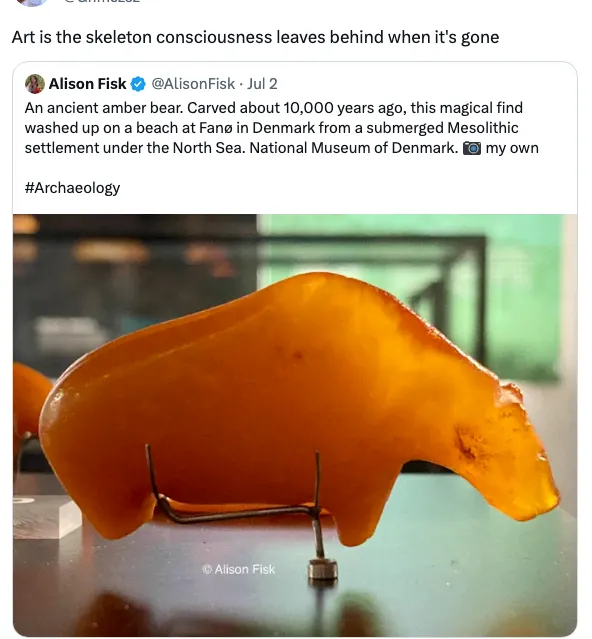
The Perfection of Art (Aug 2023)
Art may already have achieved perfection—not because artists have stopped improving, but because technology has made the realization of human imagination almost effortless. Tracing the evolution of artistic craft from Renaissance painting through photography, cinema, digital media, and AI, this essay distinguishes the technological perfection of art from its corruption by celebrity culture and commercial speculation. Ultimately, it argues that while the skills required to make art have become increasingly trivial, the human imagination behind its creation remains as valuable as ever.
Substack
The Alternative Church: Imagining The Future May 2021
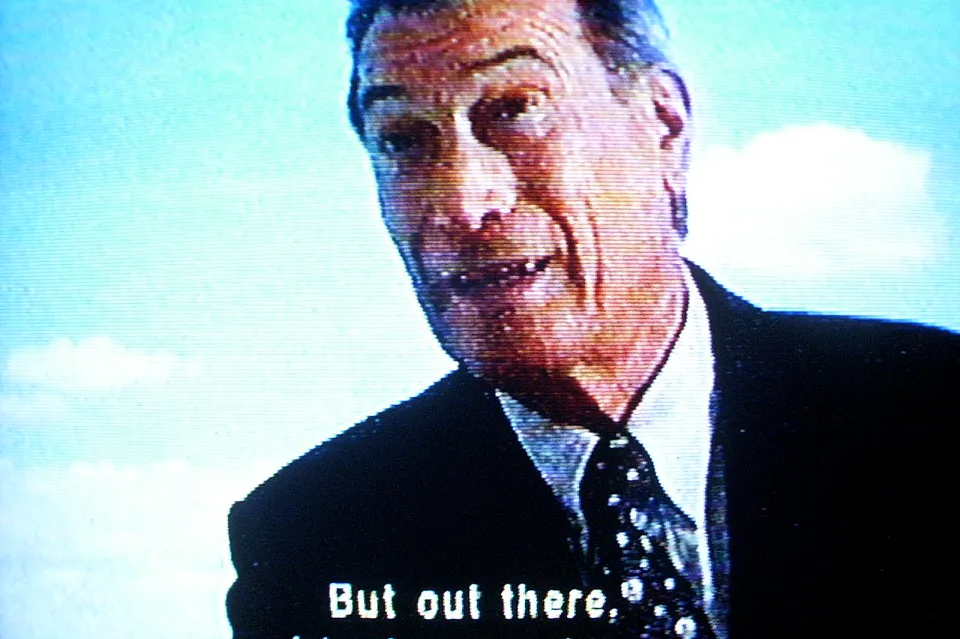
The Alternative Church: Imagining The Future (May 2021)
A lifelong fascination with the future, shaped by Star Trek, science fiction, and the experience of living through changing decades, becomes an examination of our assumptions about historical progress. Reflecting on imagined futures and the technological marvels already taken for granted, this essay considers how secular humanism has adopted the religious structures of Christianity, replacing salvation with political progress, saints with cultural heroes, and Heaven with a perfected society. It questions whether our faith in humanity’s inevitable improvement has become an alternative church, complete with its own dogmas and apocalyptic expectations.
Substack
Forgotten & Erased Apr 2021
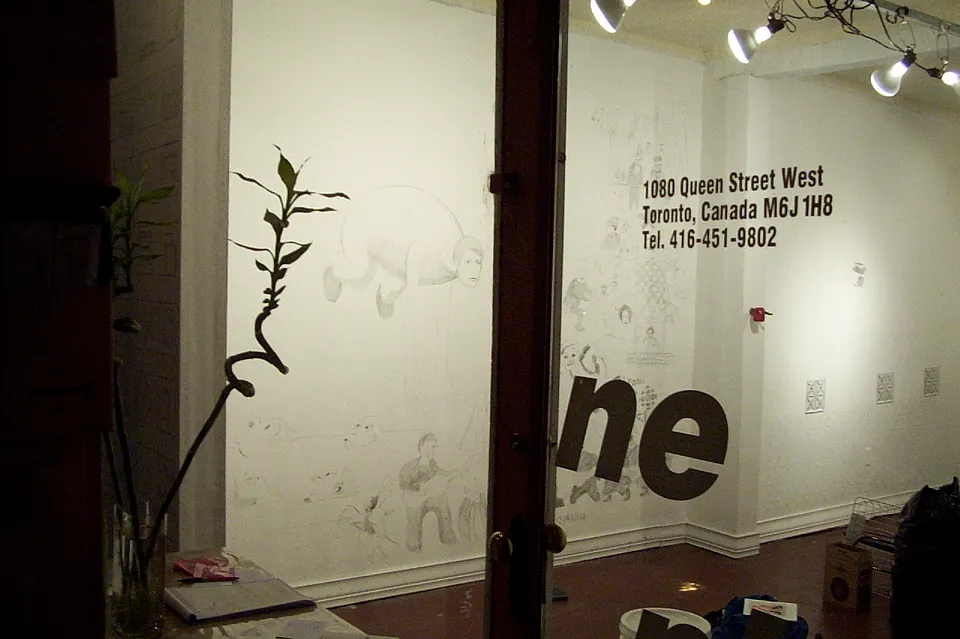
Forgotten & Erased (Apr 2021)
What happens when the people and places that shaped our lives disappear from collective memory? Revisiting Toronto’s art scene of the early 2000s, this essay recalls vanished galleries, friendships, and artists whose contributions have been forgotten or erased. Through personal anecdotes and reflections on loss, death, and the politics of cultural memory, it explores the idea that memories themselves can be works of art, while confronting their fragility and the unsettling realization that entire worlds disappear when those who remember them die.
Substack
The First Year • COVID in Ontario Mar 2021
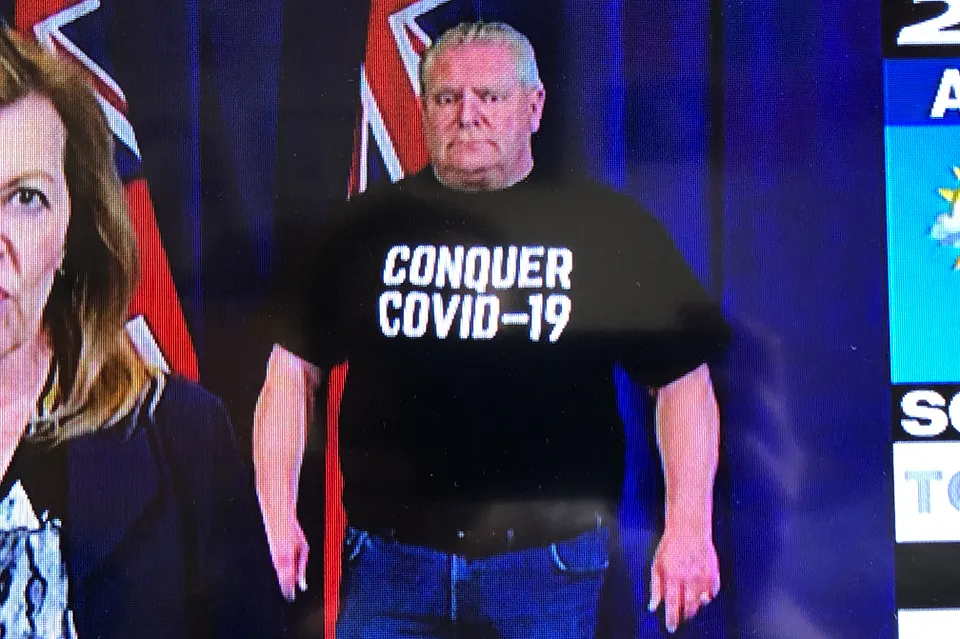
The First Year • COVID in Ontario (Mar 2021)
A year into the pandemic, Ontario is entering a third wave despite months of restrictions. Combining daily case tracking with observations from bike rides through Toronto, this essay revisits the first lockdown, the summer reopening, and the return of infections. It questions the provincial government’s willingness to manage successive waves rather than pursue elimination, while recording the queues, shuttered shops, protests, and suspended routines that marked the city’s first pandemic year.
Substack
So I created a Substack … Mar 2021
So I created a Substack … (Mar 2021)
An imagined life with a typewriter becomes a career spent working on the web. Introducing a new Substack newsletter, this essay looks back at art school, early websites, blogging, and the Goodreads.ca email list, tracing how the arrival of the internet redirected a generation’s creative ambitions. It considers what it means to keep trying new publishing platforms after decades online, still looking for an audience for the things one occasionally writes.
Substack
The Analogy of the Whale Oct 2019
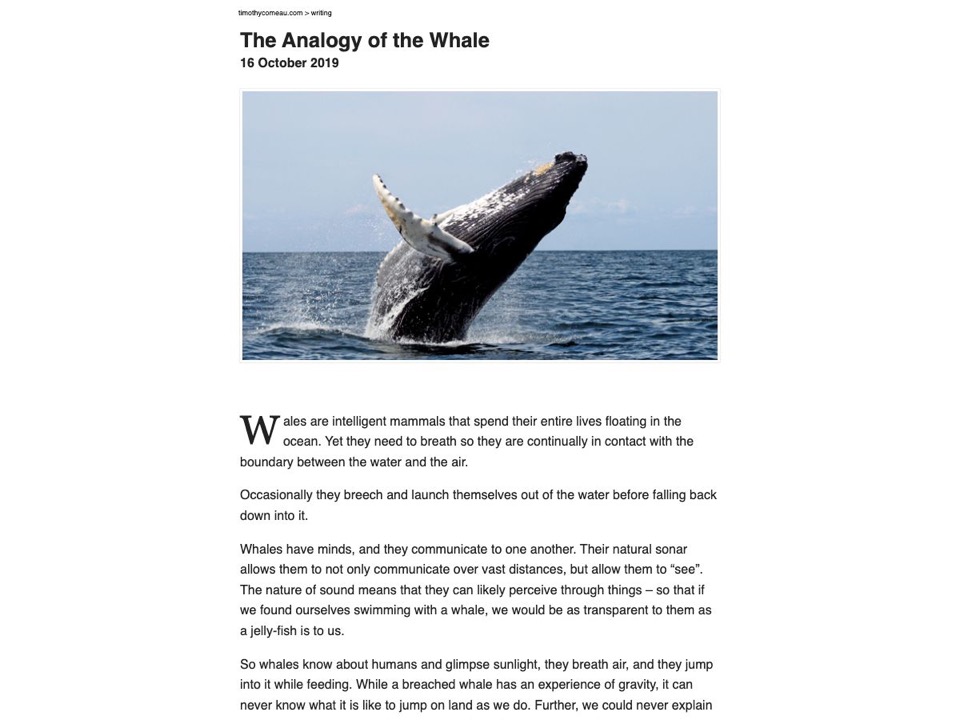
The Analogy of the Whale (Oct 2019)
What might the limits of a whale’s experience tell us about our own? Moving between the ocean, the Moon landing, and mystical experience, this essay uses the whale’s encounters with the world above water as an analogy for humanity’s glimpses of the divine. It imagines both species living at the boundary of a larger reality, capable of sensing possibilities that their ordinary lives cannot fully accommodate.
Blogging
Bitcoin! Dec 2017
Bitcoin! (Dec 2017)
Written during Bitcoin’s speculative boom in December 2017, this essay considers cryptocurrency as the beginning of a new global financial system. Drawing on science fiction, from Ian McDonald’s lunar colonies to Star Trek’s moneyless society, it explores how digital currencies might transform wealth, economic inequality, and everyday transactions. Along the way, it explains Bitcoin’s limited supply, mining, and halving cycles, arguing that its growing scarcity could reshape the financial order over the coming century.
Blogging
Archetypal Christ Jun 2017
Archetypal Christ (Jun 2017)
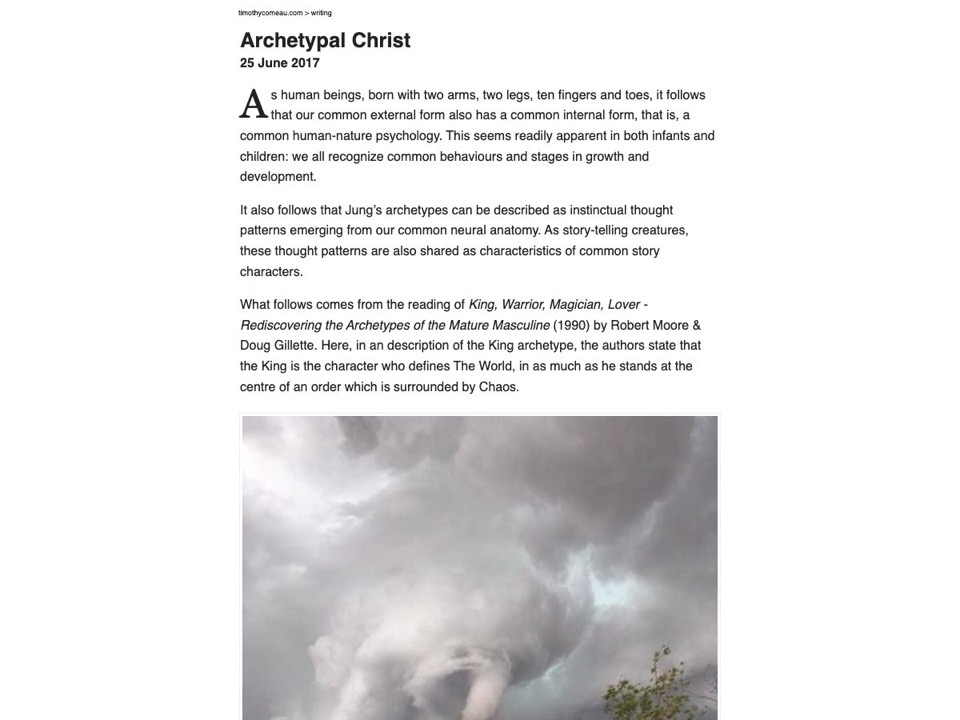
A sixth-century image of Christ becomes a way to consider the psychological appeal of religious symbols. Drawing on Jung’s archetypes and Robert Moore and Doug Gillette’s account of the King, this essay connects the halo’s divided circle with ideas of order, orientation, and a centre beyond the individual ego. It asks how Christian imagery might express instinctive patterns of human thought as well as theological beliefs.
Blogging
Kill Them With Kindness Nov 2016
Kill Them With Kindness (Nov 2016)
Written the evening after the 2016 American election, this reflection asks how to respond to a culture increasingly comfortable with cruelty. Moving between political anger, violent entertainment, and the example of everyday encounters, it argues for kindness as something practised rather than merely hoped for. Respect, patience, and life-affirming cultural choices become small ways of showing that a different kind of world remains possible.
Blogging
Rome Never Really Went Away Jul 2016
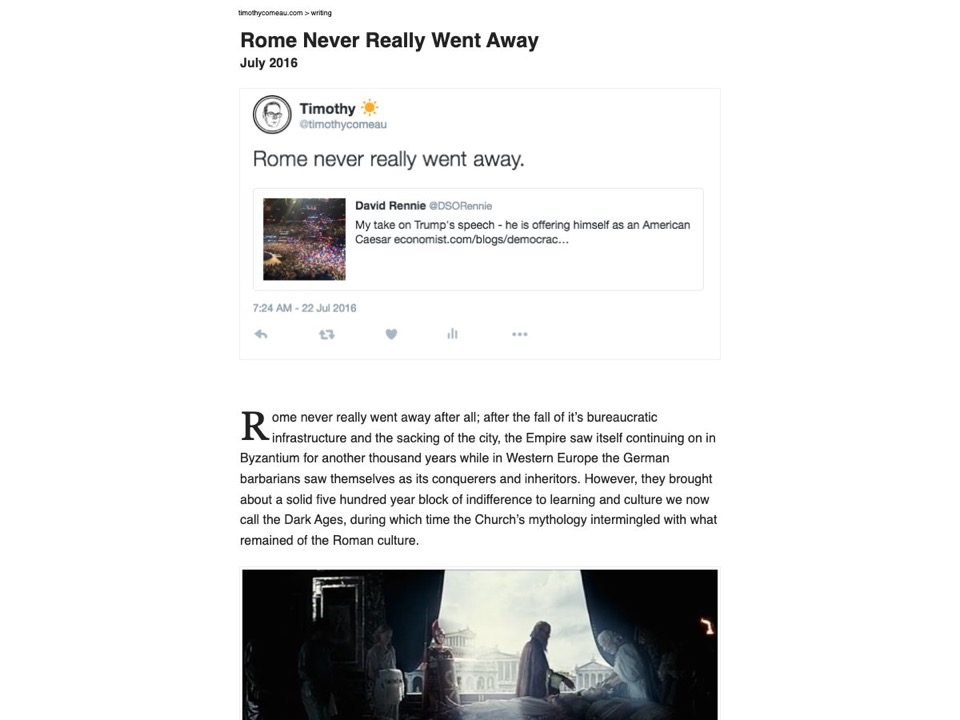
Rome Never Really Went Away (Jul 2016)
What if Rome’s fall was less an ending than a succession of inheritances? In a compressed sweep through fifteen centuries, this essay follows Roman ideas of empire through Byzantium, the Church, European monarchies, Britain, and the United States. It presents modern power as part of a continuing historical story, linking familiar political ambitions to the institutions and symbols of an ancient world that never entirely disappeared.
Blogging
The Beginnings of Rome Jul 2016
The Beginnings of Rome (Jul 2016)
How did the Romans tell the story of their own beginnings? Drawing together Livy’s history and Plutarch’s life of Romulus, this account follows the line from Aeneas to the founding of Rome, the conflict between the twins, the abduction of the Sabine women, and Romulus’s disappearance. Using Holocene dates, it places the ancient narratives alongside one another and considers how violence, political authority, and mythology shaped the city’s origin story.
Blogging
Yeezy Beecroftian Sep 2015
Yeezy Beecroftian (Sep 2015)
Kanye West’s Yeezy presentation and Vanessa Beecroft’s performances become a way to think about what contemporary culture actually looks like. Reading their work alongside William Gibson’s fiction, this essay considers branding, inequality, the objectification of women, and fashion’s attachment to the past. It argues that the much-dismissed clothing and staging might be unusually revealing art for an age of corporate power, extreme wealth, and diminished expectations.
Blogging
I bought a KeySmart Mar 2015
I bought a KeySmart (Mar 2015)
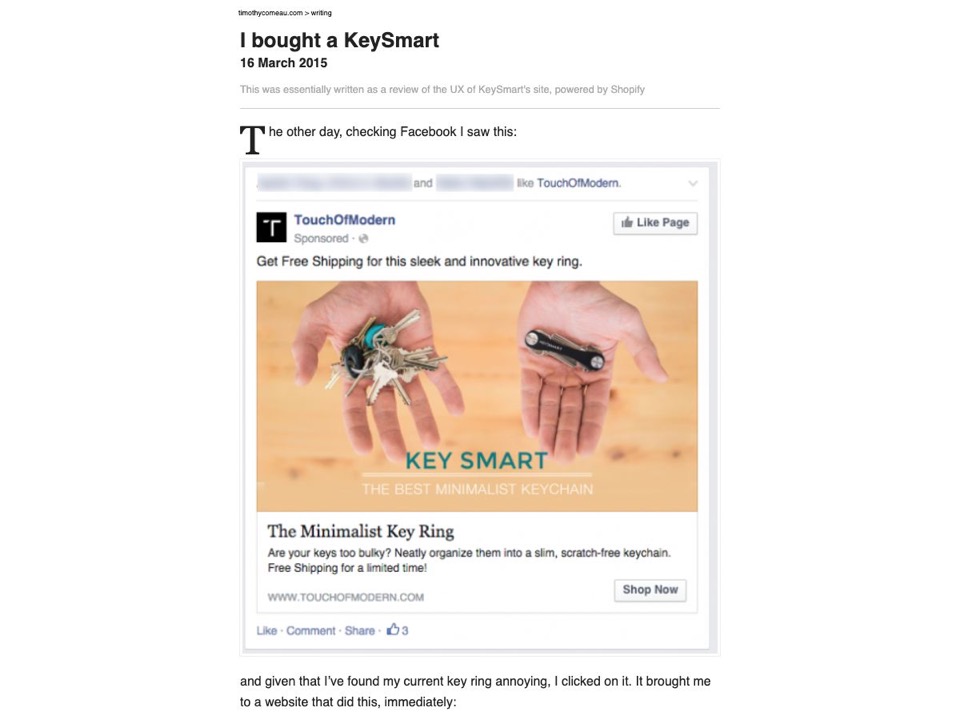
A Facebook advertisement leads through an obstructive storefront and an unhelpful Amazon listing to a purchase from KeySmart’s own website. This illustrated review compares the experience of those three routes, showing how clear information, useful product graphics, and a considerate checkout made the sale. It is a small case study in how good web design can earn a customer’s confidence.
Blogging
Markdown Reference Apr 2014
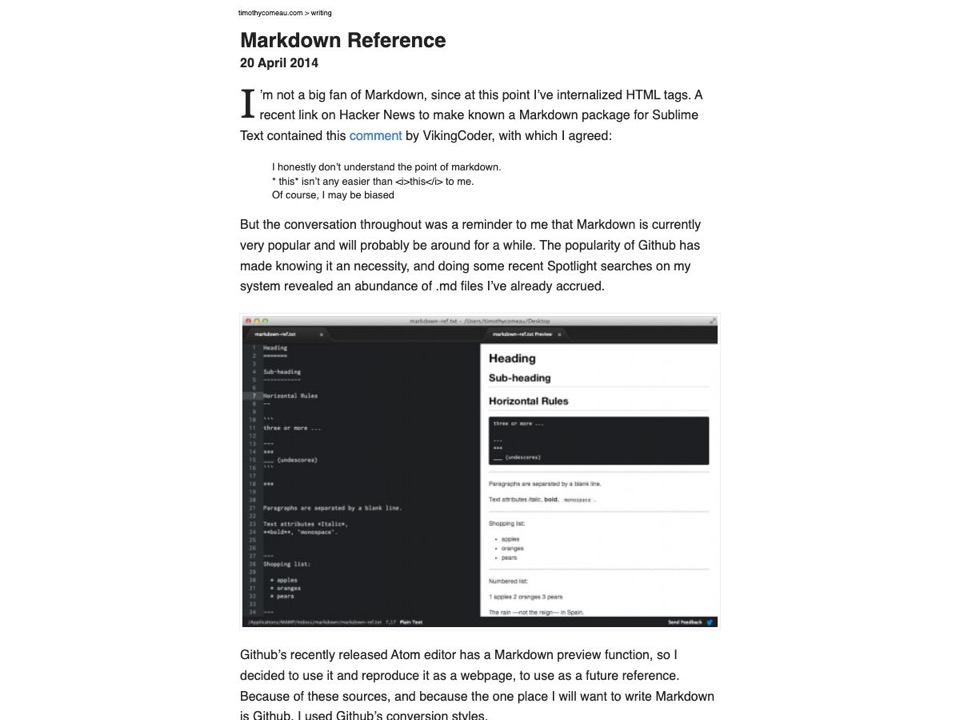
Markdown Reference (Apr 2014)
A personal reference page grows out of reluctant acceptance that Markdown has become part of everyday web work. Reflecting on the familiarity of HTML and the popularity of GitHub, this short introduction explains the decision to build a Markdown cheatsheet using GitHub-style formatting and Atom’s preview tools. It links to the reference and credits the resources used to make it.
Blogging
Learning Git Apr 2014
Learning Git (Apr 2014)
Git becomes easier to use once its underlying model makes sense. Written for beginners who have followed tutorials but remain confused, this guide approaches version control through the history of the command line, practical examples, and explanations of staging, commits, and branches. It shares the sketches and conceptual steps that made Git understandable, along with a personal reference sheet and links to further learning resources.
Blogging
Her Jan 2014
Her (Jan 2014)
Spike Jonze’s Her becomes an occasion to think about intimacy, loneliness, and life with increasingly intelligent machines. Moving from the film’s hipster styling to its portrayal of an operating system as companion, this essay considers how devices already extend memory, conversation, and emotional experience. It reads the film as an early cultural signpost for augmented humanity, asking what relationships might become possible as our minds grow beyond their familiar boundaries.
Blogging
Don't Make me Think (About Publishing) Oct 2013
Don't Make me Think (About Publishing) (Oct 2013)
What does a web developer do when the web is no longer a novelty? Beginning with Steve Krug’s usability advice and a film about Hannah Arendt, this essay separates the convenience of a well-designed service from the broader value of thought. It then places digital work in the longer history of printing, suggesting that websites, apps, and ebooks are becoming ordinary forms of publishing—and that future historians may describe today’s developers simply as publishers.
Blogging
The Prosthetic Hallucination (on Google Glass) Oct 2013
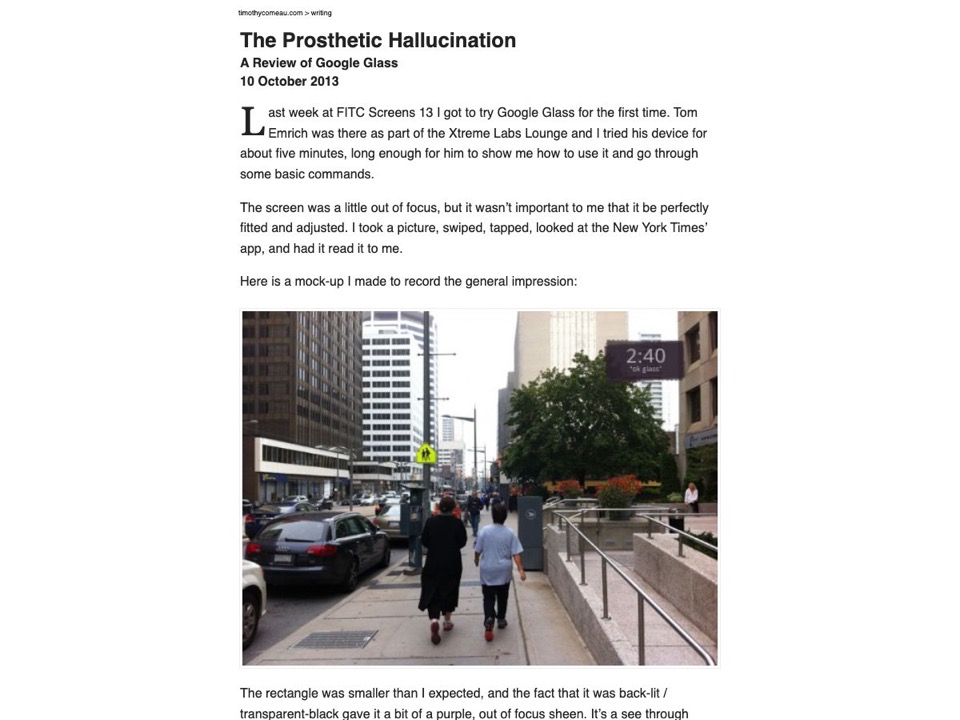
The Prosthetic Hallucination (on Google Glass) (Oct 2013)
Five minutes with Google Glass reveal a small screen with surprisingly complicated social consequences. This account of trying the device at FITC Screens 2013 considers its unfamiliar gestures, private visual field, and effects on the people around its wearer. Drawing comparisons with early mobile phones and science-fiction displays, it asks how a useful extension of perception might become part of everyday life without making human interaction harder.
Blogging
Reflections on a Subway Sandwich Sep 2013
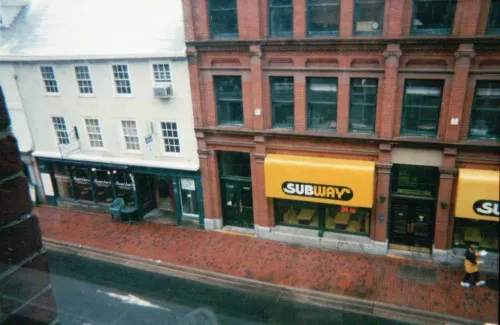
Reflections on a Subway Sandwich (Sep 2013)
A sandwich eaten in Halifax in 1993 becomes a point of connection between art school, early blogging, and the development of Flickr. Looking back twenty years, this essay follows the unexpected paths linking a familiar street corner to Aaron Straup Cope’s career and the arrival of the web. It reflects on how futures take shape around us long before we can recognize what they will become.
Blogging Substack
Retro Minimalism Aug 2013
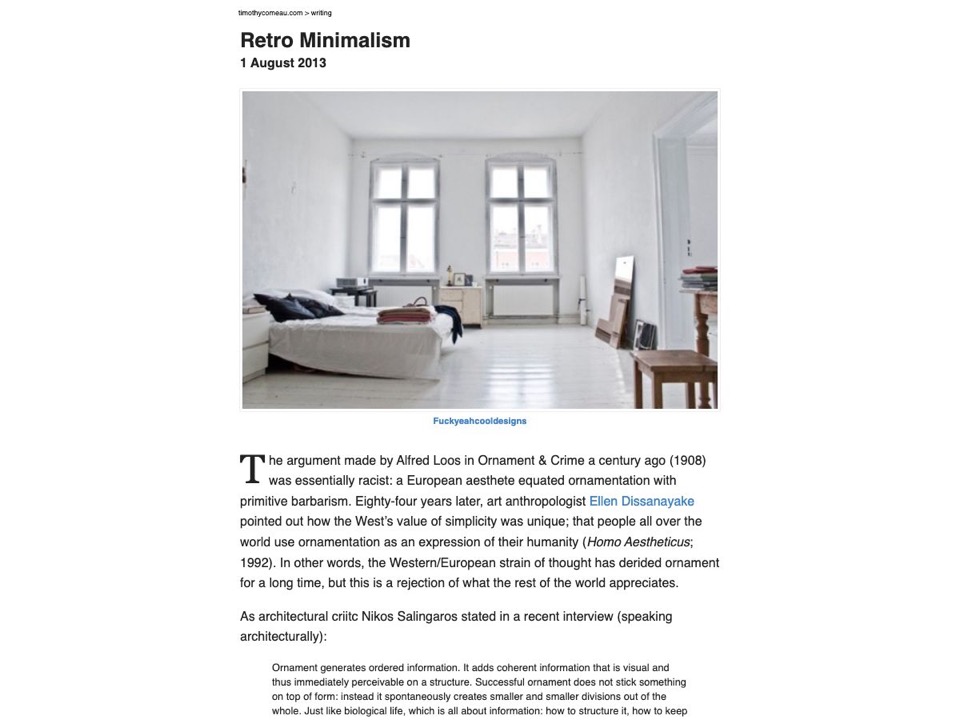
Retro Minimalism (Aug 2013)
Why do we associate simplicity with sophistication and worn objects with authenticity? Drawing on architectural criticism, anthropology, and science-fiction interiors, this essay considers the uneasy relationship between minimalist futures and a culture fascinated by retro styles. It questions the Western rejection of ornament and asks whether nostalgia might also be a way of deciding which parts of the twentieth century deserve a lasting place in contemporary life.
Blogging
King Baby of the 21st Century Jul 2013
King Baby of the 21st Century (Jul 2013)
The birth of Prince George prompts a speculative royal timeline stretching into the twenty-second century. Written in 2013, this short exercise imagines unusually long lives for Elizabeth, Charles, William, and George, asking how an ordinary news event might become part of the distant future. Its predictions preserve a snapshot of that moment’s expectations rather than a retrospective account of the succession.
Blogging
Chrome History Aug 2012
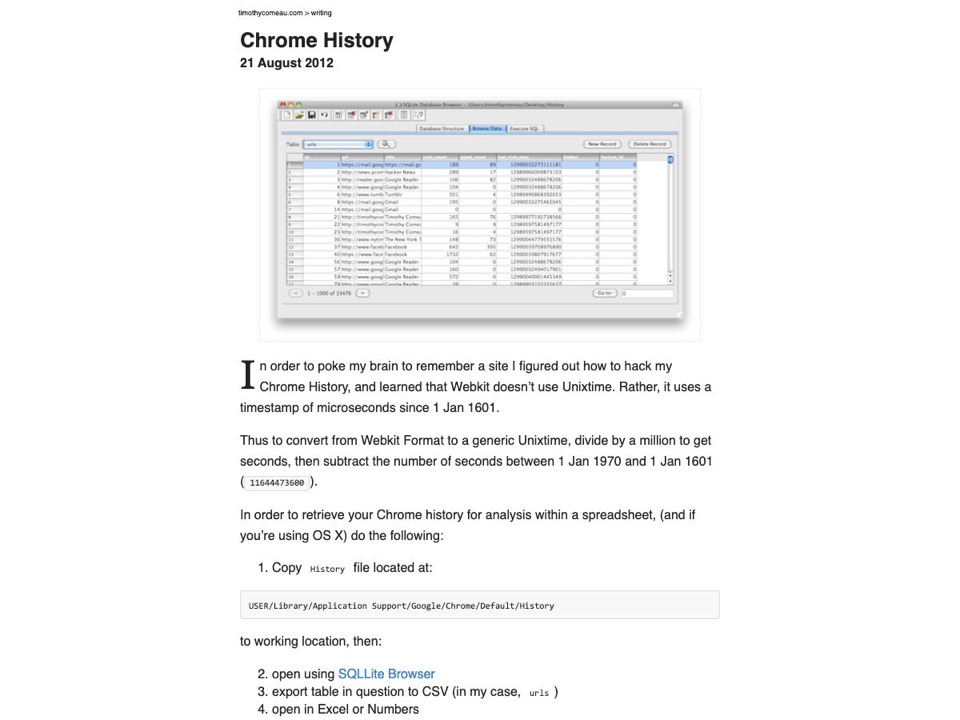
Chrome History (Aug 2012)
Trying to remember a website leads to a practical investigation of Chrome’s history database. This short guide explains how to export browsing records and convert WebKit timestamps into readable dates in a spreadsheet. A later addition includes a reader’s Python alternative, turning a small act of digital memory recovery into a reusable reference.
Blogging
The Mechanism Aug 2012
The Mechanism (Aug 2012)
In Alastair Reynolds’s Blue Remembered Earth, surveillance has become intimate enough to interrupt violence before it happens. This essay examines the novel’s Mechanism alongside childhood ideas of an all-seeing God, religious imagery, and the social effects of climate change. It asks what might be gained and lost in a world without conventional crime or prisons, where safety depends on constant monitoring of human thought and behaviour.
Blogging
Posterity Engines Jul 2012
Posterity Engines (Jul 2012)
A phrase from Alastair Reynolds’s Blue Remembered Earth suggests a future for the digital records we are already accumulating. This essay considers personal archives large enough to preserve generations of memories, and the systems needed to retrieve them. Moving from desktop search to Wikipedia, it asks whether our current emphasis on searching obscures the more interesting questions of what we find, preserve, and pass on.
Blogging
Websites of the 2080s May 2012
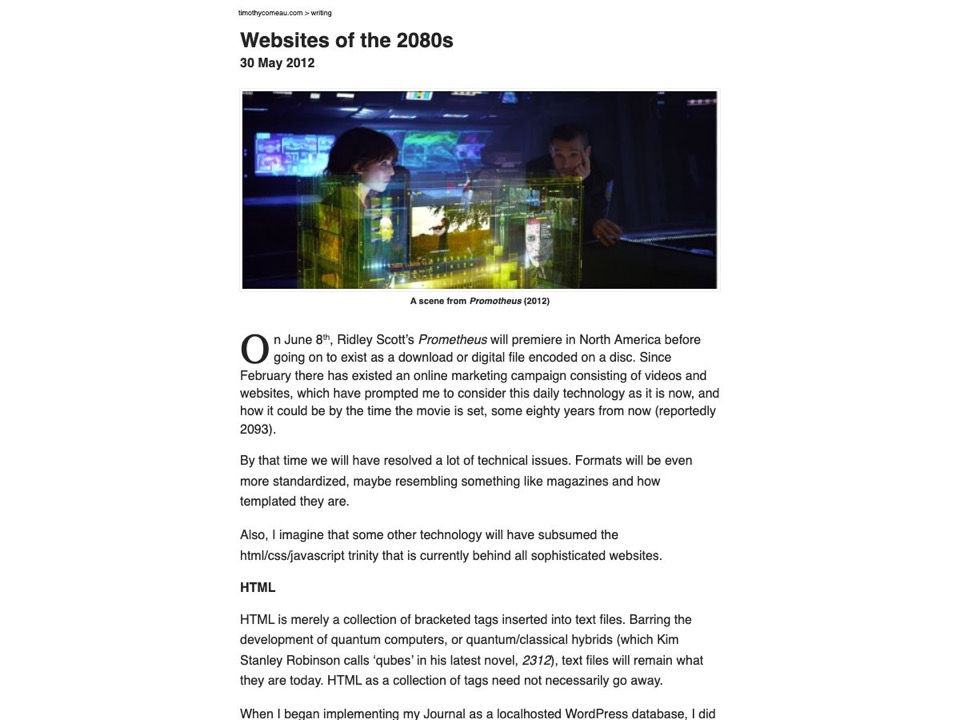
Websites of the 2080s (May 2012)
The promotional websites for Prometheus prompt a question about the web’s own future: what will a website look like in eighty years? Written in 2012, this essay considers the durability of plain text, the evolution of HTML, CSS, and JavaScript, and the growing complexity of WordPress. It imagines a future in which familiar technical layers have become simpler to manage while the pages we make today remain readable.
Blogging
Medium Specificity Feb 2012
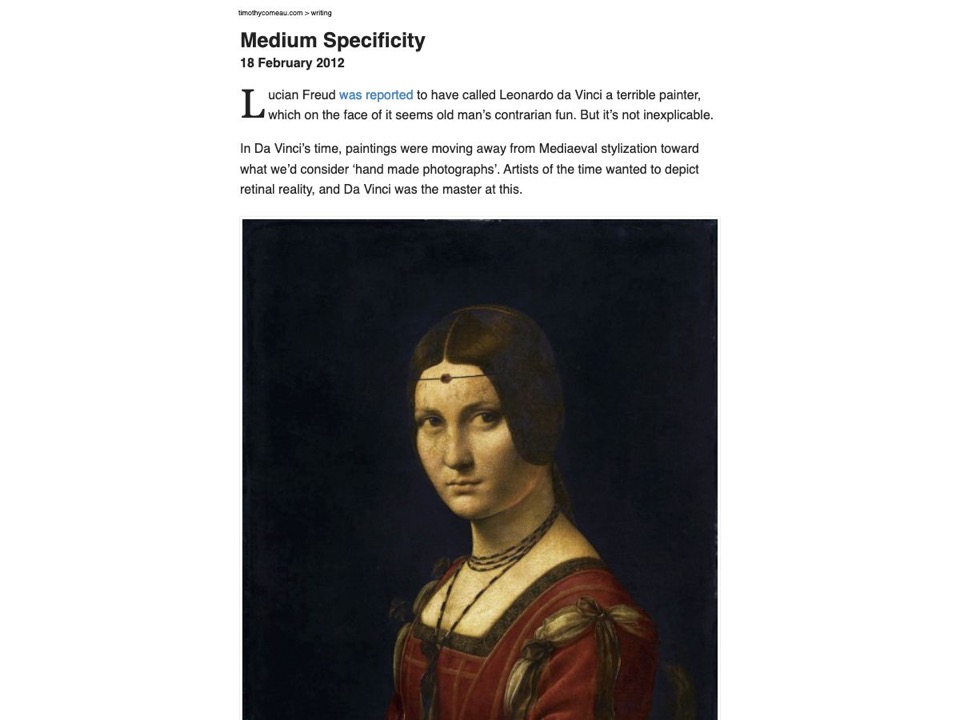
Medium Specificity (Feb 2012)
Lucian Freud’s reported dismissal of Leonardo da Vinci opens a discussion of what different eras expect painting to do. Moving through Renaissance illusion, modernist medium specificity, Dickens, the Arts and Crafts movement, and arguments against ornament, this essay traces the changing authority of materials and representation. It asks how preferences that appear to be matters of taste carry longer histories of religious prohibition, industrialization, and cultural judgment.
Blogging
Applying timeless page design to the Web Feb 2012
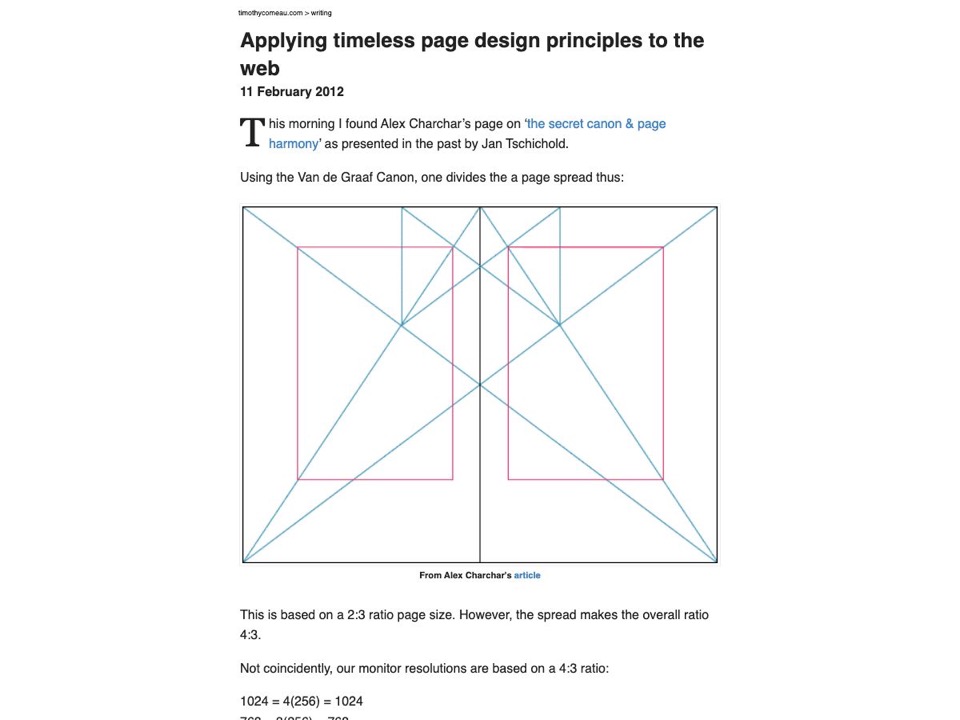
Applying timeless page design to the Web (Feb 2012)
Can the proportions used in traditional book design help organize a responsive webpage? Working from Jan Tschichold’s presentation of the Van de Graaf canon, this illustrated experiment translates a page’s geometric divisions into a nine-by-nine grid and percentage-based CSS. It connects manuscript and print traditions with the practical problem of arranging content across changing screen sizes, ending with a working demonstration.
Blogging
Leonardo da Vinci's Emblems Jan 2012
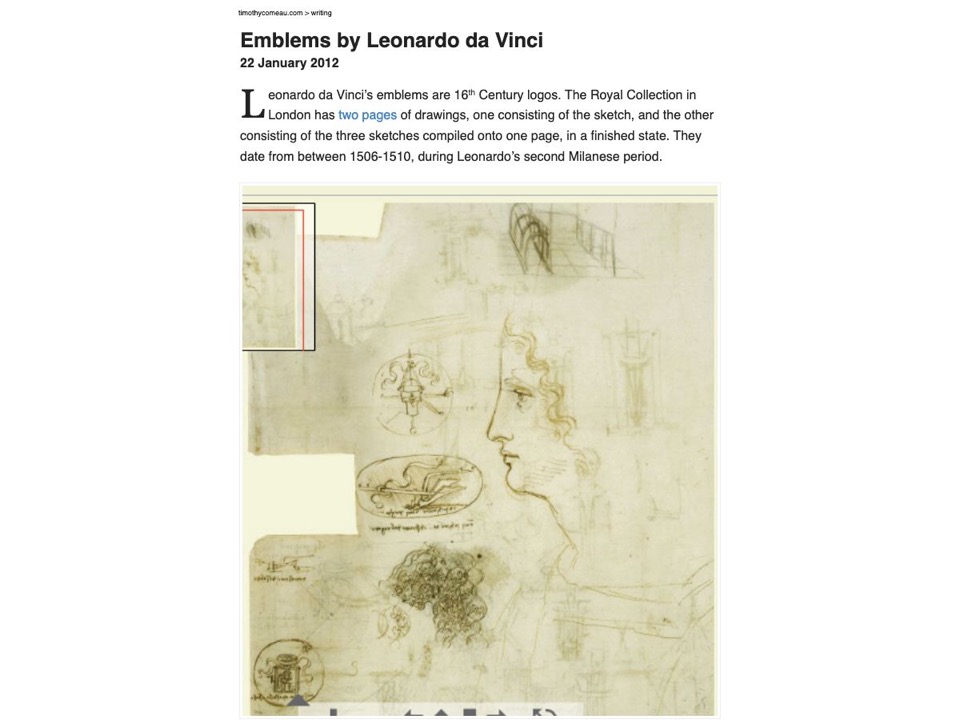
Leonardo da Vinci's Emblems (Jan 2012)
Leonardo da Vinci’s emblem drawings are considered as early examples of logo design. Looking closely at two sheets in the Royal Collection, this short visual essay proposes that a nearby profile drawing may have supplied forms for the emblems. The curl of hair, the curve of a ribbon, and the arrangement of a face become clues to the abstraction of identity into a mark.
Blogging
How it's Been Nov 2011
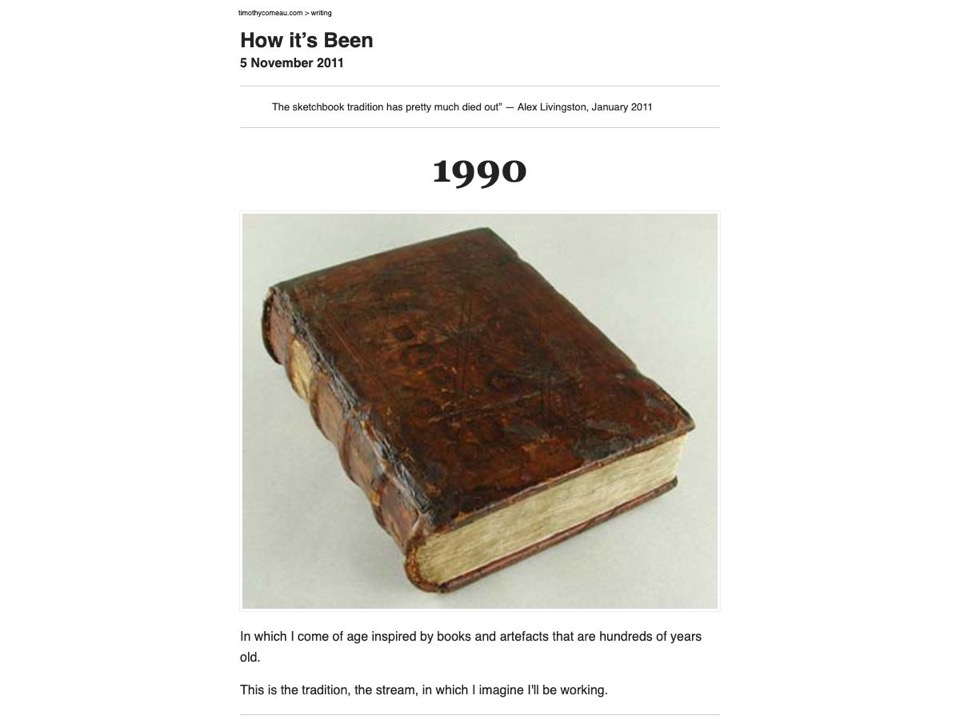
How it's Been (Nov 2011)
Three moments—1990, 1995–2005, and 2011—outline a changing relationship with artistic materials. This brief illustrated reflection moves from an ambition to make objects that might survive for five hundred years to a present of iPhones, iPads, and digitally produced art. It captures the disorientation of entering a paperless future after imagining a life within the traditions of notebooks, manuscripts, and paintings.
Blogging
The Sketchbook Tradition Jan 2011
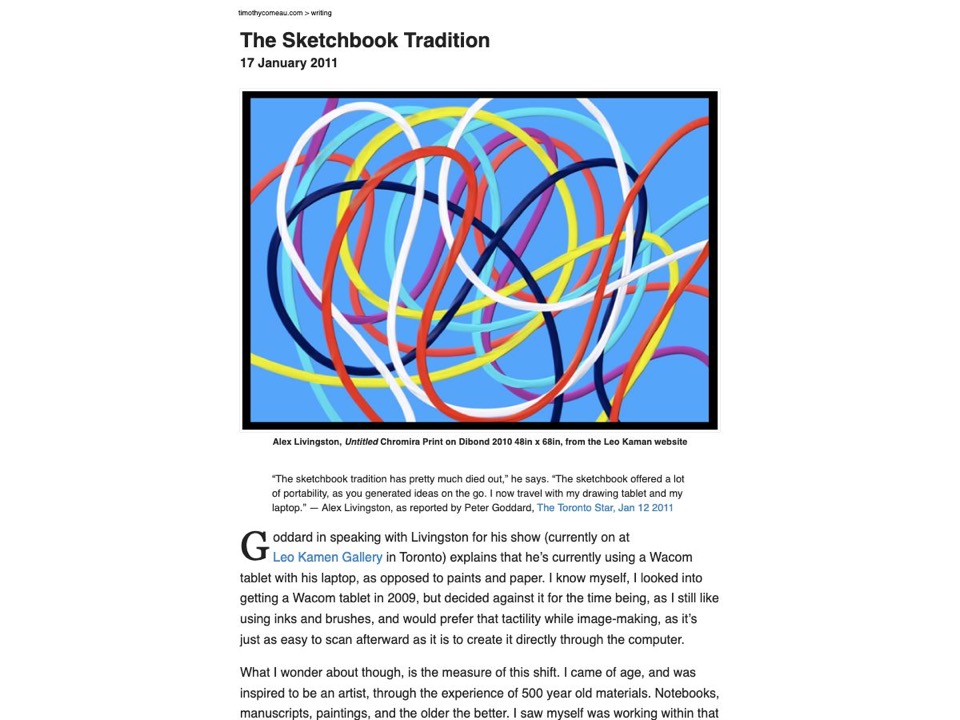
The Sketchbook Tradition (Jan 2011)
An art professor’s move from sketchbooks to a drawing tablet raises questions larger than a change of tools. Responding to Alex Livingston’s digital practice, this essay reflects on the tactile pleasures of ink and brushes and the inspiration of centuries-old manuscripts. It asks what happens to an artist’s sense of continuity when the materials that shaped an imagined future begin to disappear from ordinary use.
Blogging
Three Versions of Western Art History Apr 2010
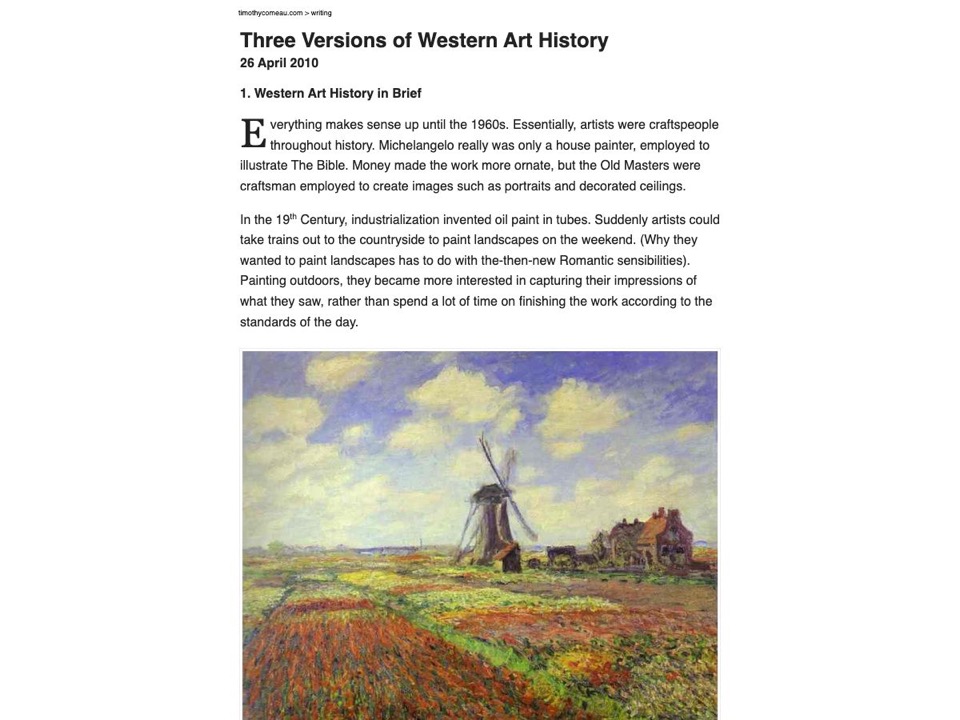
Three Versions of Western Art History (Apr 2010)
Three deliberately compressed versions of Western art history offer competing ways of telling the same story. The first follows the movement from skilled craft toward artistic freedom; the second recasts that freedom as a possible sign of civilizational exhaustion; the third punctures the entire exercise with an outsider’s impatience. Illustrated examples make this an irreverent reflection on progress, decline, and the assumptions behind art-historical narratives.
Blogging
Avian Aspirations Feb 2010
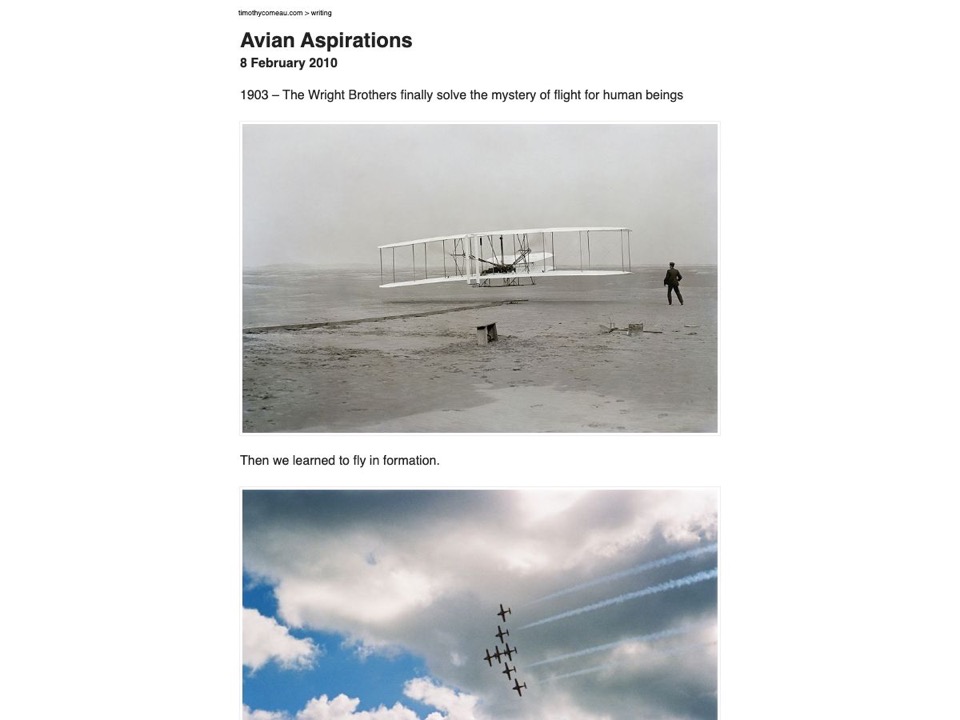
Avian Aspirations (Feb 2010)
From the Wright brothers to Twitter, a century of inventions suggests an unlikely human ambition: becoming birdlike. This short visual reflection links powered flight, formation flying, and networked communication, imagining social media as the chatter of a flock. It playfully asks whether technologies that seem separate might share an older desire to escape the limits of being an earthbound ape.
Blogging
The iPad Jan 2010
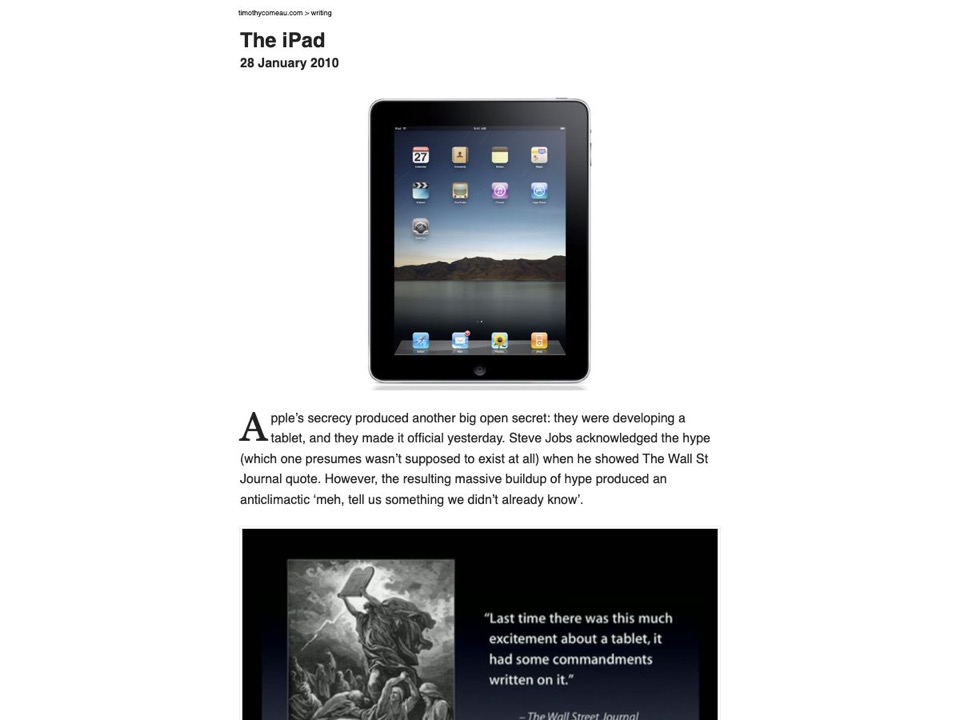
The iPad (Jan 2010)
Written the day after Apple announced the first iPad, this response considers why a remarkable device could still feel unsurprising. Decades of science fiction had already prepared audiences for portable screens, making invention look like the arrival of something familiar. Connecting Star Trek, industrial design, and the dismissal of arts education, it argues that Apple’s success demonstrates the practical value of imagination and aesthetic judgment.
Blogging
Michael Jackson’s Art Dec 2009
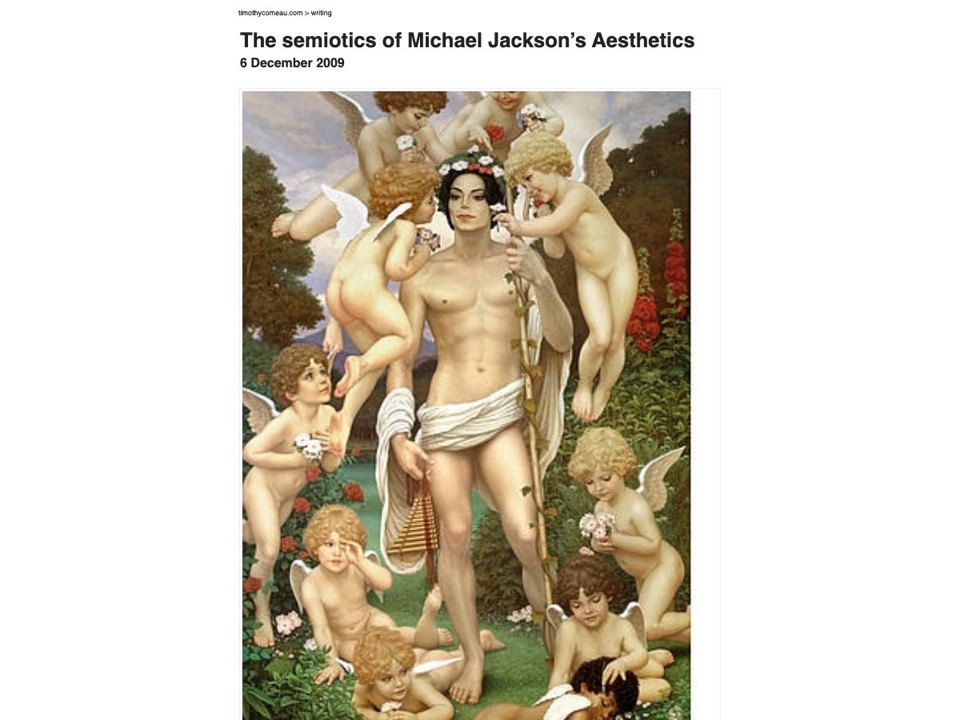
Michael Jackson’s Art (Dec 2009)
Michael Jackson’s commissioned portraits become evidence for a sharply critical reading of celebrity self-mythology. Examining images of Jackson as king, knight, and near-divine figure, this essay connects his visual world to royal propaganda, personality cults, and the survival of figurative painting outside fashionable art institutions. It asks what these objects might communicate to future viewers about fame, power, and the culture that produced them.
Blogging
Mad Men with Blackberries Sep 2009
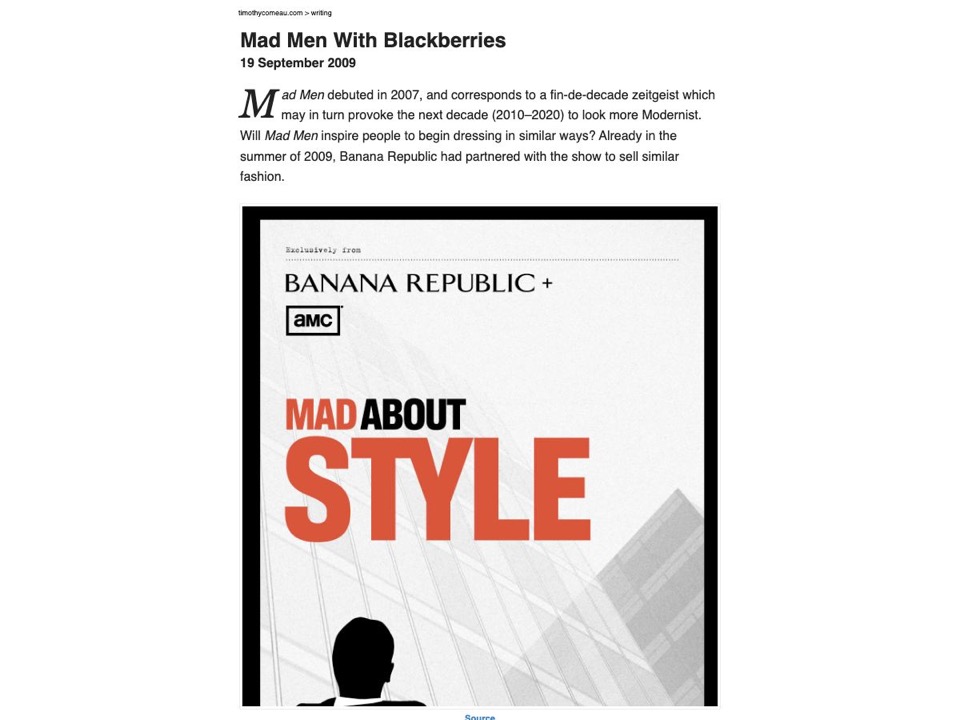
Mad Men with Blackberries (Sep 2009)
Could the popularity of Mad Men help make the next decade look like the mid-twentieth century? Written in 2009, this illustrated speculation connects television costumes, Toronto’s Drake Hotel, and the retro-futuristic design of Caprica. It imagines a technologically advanced society dressed in revived modernist styles, then asks whether future viewers will recognize the deliberate nostalgia or mistake it for the ordinary appearance of the times.
Blogging
How long will I live? May 2009
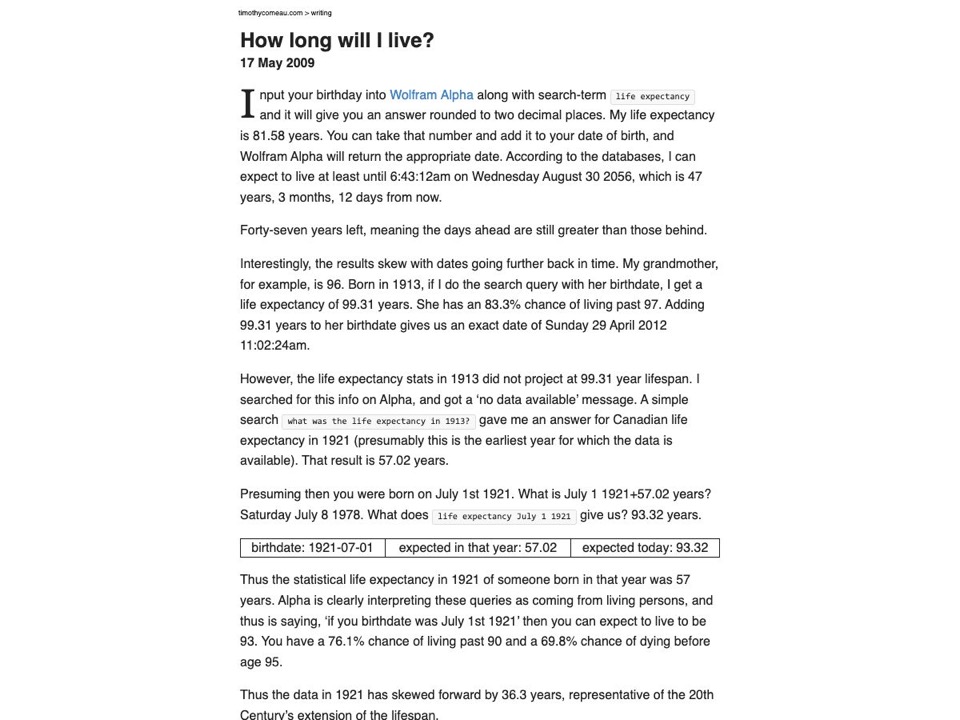
How long will I live? (May 2009)
A life-expectancy query in Wolfram Alpha turns into an experiment with birthdays, statistics, and imagined futures. Comparing projections for different generations, this essay explores the gap between expectations at birth and estimates for people who have already survived into old age. Its precise, speculative dates make the abstract question of a remaining lifespan feel strangely concrete; a later note records a grandmother outliving the original calculation.
Blogging
The Fall of the Harper Government Dec 2008
The Fall of the Harper Government (Dec 2008)
Written during Canada’s December 2008 coalition crisis, this essay considers Stephen Harper’s decision to prorogue Parliament rather than face a confidence vote. It imagines how events might otherwise have unfolded and examines the competing claims about coalitions, elections, and democratic legitimacy. Anger at partisan tactics sits alongside concern about economic policy, political leadership, and the gap between parliamentary government and the way it was being presented to Canadians.
Blogging
Mammalian Diving Reflex Jun 2008
Mammalian Diving Reflex (Jun 2008)
A debate about Darren O’Donnell’s Mammalian Diving Reflex becomes a discussion of what socially engaged art can make possible. Drawing on personal involvement in the projects, critical responses, and Christopher Alexander’s ideas about children and cities, this essay defends encounters that disrupt familiar divisions between age groups and social roles. It argues that the work’s value lies partly in expanding the relationships and experiences a community can imagine for itself.
Blogging
The Shameful Minimum Wage Apr 2008
The Shameful Minimum Wage (Apr 2008)
Memories of minimum-wage work in Halifax inform a blunt response to employers who say they cannot afford better pay. Written after an Ontario wage increase in 2008, this short essay questions business models dependent on enforced poverty and notices how rising food and transit costs can absorb workers’ gains. It asks whether nominal improvements mean much when the surrounding economy continually restores the same unequal conditions.
Blogging
The 22nd Century City Dec 2007
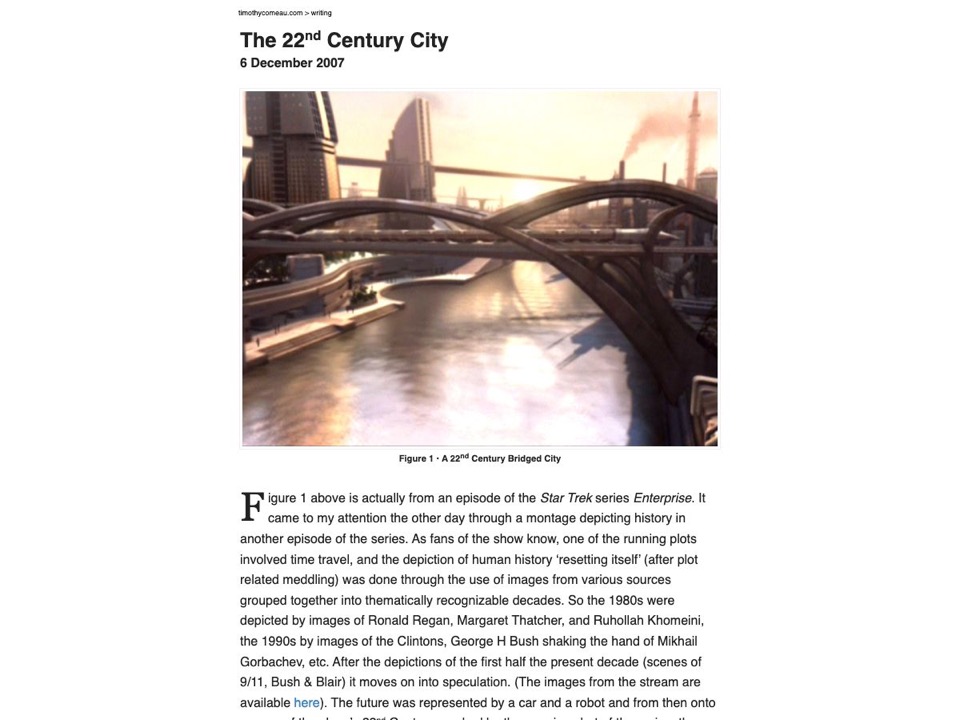
The 22nd Century City (Dec 2007)
What kind of city would we actually want to inhabit in the twenty-second century? Comparing imagined places in Star Trek, Battlestar Galactica, and The Lord of the Rings with Toronto’s development, this essay challenges the assumption that technological progress must look like glass towers and concrete. It brings traditional urban design into the discussion and argues for a future that combines modern conveniences with beauty, greenery, and humane public space.
Blogging
Blade Runner: The Final Cut Nov 2007
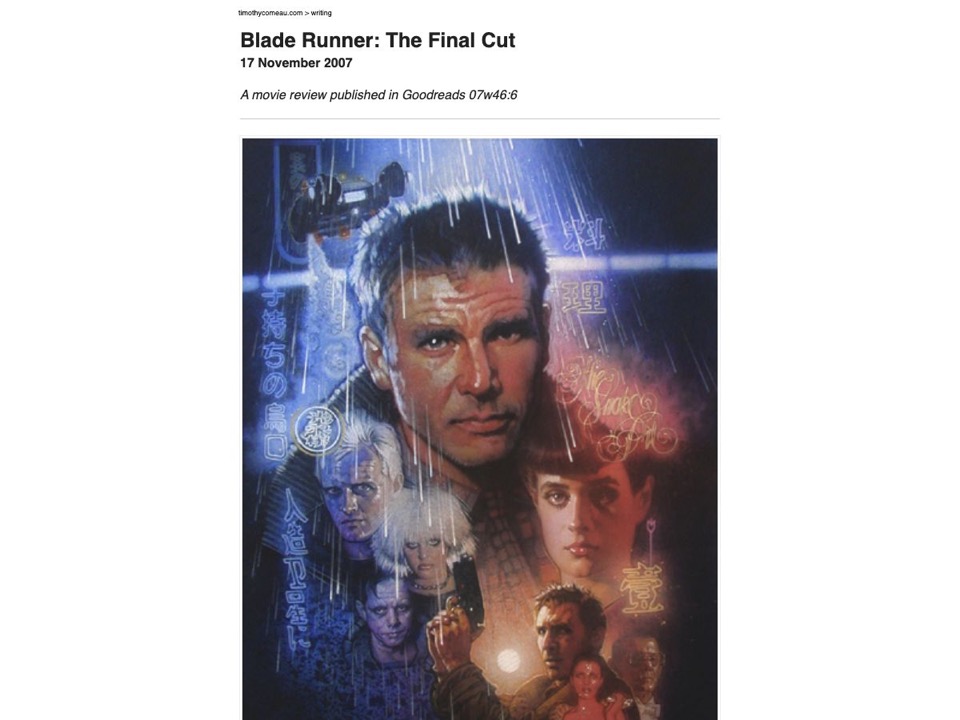
Blade Runner: The Final Cut (Nov 2007)
Seeing Blade Runner: The Final Cut on a cinema screen prompts a personal history of living with the film’s imagined future. This review considers its settings, visual restoration, and relationship to science-fiction design, comparing changes to the image with the cleaning of the Sistine Chapel. It argues that the film’s power lies less in its plot than in its achievement as an animated narrative painting.
Blogging
Dante and the Canadian November Nov 2007
Dante and the Canadian November (Nov 2007)
Canada’s November brings both the Massey Lectures and Remembrance Day, occasions this essay sees as expressing conflicting cultural impulses. Moving through Doris Lessing, Roman imperial history, contemporary entertainment, and Dante, it contrasts the cultivation of thought with the persistent glamour of violence. Dante’s imagined Heaven becomes a counterexample to a culture more readily moved by cruelty, asking why peaceful beauty should seem less compelling than destruction.
Blogging
The Perils of Bad Writing Sep 2007
The Perils of Bad Writing (Sep 2007)
Ambiguous grammar, hostile email, and ineffective drinking-water warnings show how failures of writing can become failures of judgment. This essay follows several cases in which careless or obscure language has consequences beyond style, from a defamation dispute to public-health communication. Drawing on John Ralston Saul’s criticism of specialist dialects, it argues that clarity is a practical responsibility, especially when institutions mistake complexity of language for importance.
Blogging
Luminato? Jun 2007
Luminato? (Jun 2007)
Toronto’s first Luminato festival prompts a critique of culture organized around sponsorship, spectacle, and attendance figures. Responding to newspaper assessments and the installations he encountered, the author asks what a more imaginative public cultural experience could offer. The essay connects festivals, architecture, and social priorities, arguing that success should be measured through lasting memories and wonder rather than the number of people passing through.
Blogging
The Fantastics Mar 2007
The Fantastics (Mar 2007)
Four encounters offer different versions of the fantastic: Darren O’Donnell’s theatre, scientific interest in Buddhist monks, Zin Taylor’s exhibition, and Michael Kuchma’s criticism of Thrush Holmes. This essay considers the pleasure of approaching things without an insider’s cynicism, while remaining impatient with shallow cultural judgment. A later memorial to Kuchma adds a more personal reflection on friendship, exclusion, and the fragility of an online record.
Blogging
The Modern, Nodern, Podern, and Qodern Feb 2007
The Modern, Nodern, Podern, and Qodern (Feb 2007)
A future historian looks back on an era unable to stop calling itself “post” something. Replacing the prefix with a playful alphabetical sequence, this speculative essay traces modernism into the cultural and political conditions of the early twenty-first century, then imagines what might follow. Media, identity, technology, and social change become parts of a hopeful account of a future organized around creativity, education, and wider participation.
Blogging
Free Expression Feb 2007
Free Expression (Feb 2007)
What makes freedom of expression useful, and when does it merely repeat prejudice? Beginning with Theodore Dalrymple’s complaints about political correctness, this essay moves through interviews with political leaders, media habits, and the difficulty of encountering unfamiliar views. It defends exposure to disagreement as a way of enlarging thought, while questioning whether a commercially narrowed public conversation gives that freedom much room to work.
Blogging
Mr. Mee Jan 2007
Mr. Mee (Jan 2007)
Andrew Crumey’s Mr. Mee weaves an elderly internet novice, eighteenth-century copyists, and a dying professor into a meditation on books and identity. This appreciative review follows the novel’s connections to Rousseau, Proust, early web culture, and the imaginative translation of modern physics into an older world. At its centre is the possibility that writing does more than preserve a life: it helps create the self whose story is being told.
Blogging
A Poem Nov 2006
A Poem (Nov 2006)
A restless prose poem moves between the instability of identity, disillusionment with the art world, consumer culture, aging, and the wish for an ordinary, peaceful life. Literary echoes and abrupt changes of scene give shape to an argument that never settles into a single voice. Beneath its anger and satire lies a search for something less dependent on status, appearances, and the exhausting need to explain oneself.
Blogging
The Language of Quotation Oct 2006
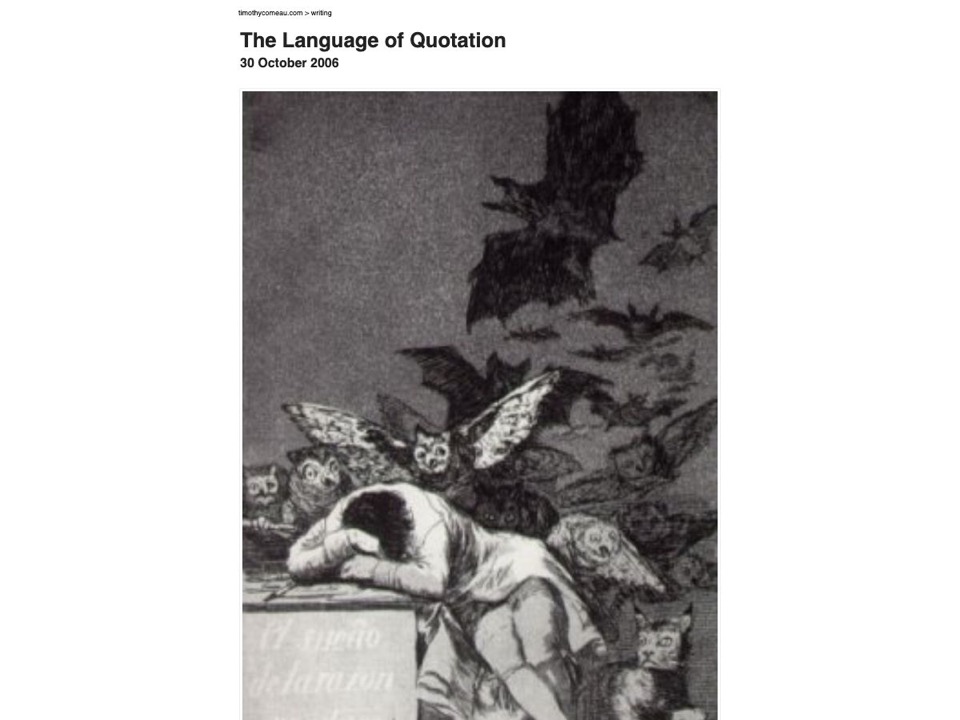
The Language of Quotation (Oct 2006)
Borges’s idea of language as a system of quotations opens a reflection on familiar scripts in television, politics, and public life. Responding in particular to the film Death of a President, this essay examines how images assembled from the present can make an invented future feel like documented history. It asks what happens when ritualized stories and borrowed gestures become the means through which a culture understands both entertainment and power.
Blogging
The Luxury of Terrorism Sep 2006
The Luxury of Terrorism (Sep 2006)
Warnings about food supplies and civilizational breakdown frame a bitterly satirical look at the priorities of the early twenty-first century. Drawing on Thomas Homer-Dixon and Adam Curtis’s documentaries, this essay connects the spectacle of terrorism with consumerism, public relations, and the management of individual desire. It asks what a meaningful shared life might look like beyond those scripts, while finding some hope in the internet’s capacity to support independent learning and new communities.
Blogging
Suicide is news too Sep 2005
Suicide is news too (Sep 2005)
Why are some deaths routinely reported while others remain surrounded by silence and rumour? Written for BlogTO in 2005, this polemic questions the news media’s treatment of suicide, contrasting it with the daily prominence given to crime and accidents. It argues for a more honest public understanding of distress and alienation, asking what a city fails to learn about itself when those experiences are absent from its account of everyday life.
BlogTo
Signs of the Times: the lockout and the future Aug 2005
Signs of the Times: the lockout and the future (Aug 2005)
The CBC lockout of 2005 becomes a vantage point on changes in Canadian politics, broadcasting, and public participation. This essay connects the labour dispute with the rise of blogging and podcasting, asking whether journalists shut out of their familiar institutions might discover more direct ways to reach an audience. Behind the passing summer disruption, it sees the possibility of a new relationship between citizens, media, and the people accustomed to speaking for them.
BlogTo
Zsa Zsa Gallery 1998 – 2005 Aug 2005
Zsa Zsa Gallery 1998 – 2005 (Aug 2005)
Zsa Zsa Gallery’s final exhibition offers a way to remember the friendships and opportunities sustained by Andrew Harwood’s Queen West space. Reviewing Bedknobs & Broomsticks, this essay follows a shared interest in blankets, craft, queer culture, and domestic materials through several artists’ work. It records the closing of a gallery that was also a home, considering how a local aesthetic takes shape through personal relationships as much as through individual objects.
BlogTo
Toronto is NOT next Jul 2005
Toronto is NOT next (Jul 2005)
In the aftermath of the July 2005 London bombings, this polemic challenges predictions that Toronto must be next. It questions news coverage built around fear, draws on Adam Curtis’s account of the politics of terrorism, and examines the mixed messages surrounding transit vigilance. Written in the heat of that moment, it argues that public reassurance and clear communication would serve the city better than a continuous atmosphere of anticipated catastrophe.
BlogTo
Toronto Outdoor Art Fair Jul 2005
Toronto Outdoor Art Fair (Jul 2005)
A brief invitation to the 2005 Toronto Outdoor Art Exhibition at Nathan Phillips Square. The post points readers toward the breadth of work on display, with particular encouragement to visit the art students, and reproduces the event’s practical information. It offers a small snapshot of a summer weekend when hundreds of artists and craftspeople brought their work into the centre of the city.
BlogTo
Interview with Lisa Pereia Jun 2005
Interview with Lisa Pereia (Jun 2005)
An email conversation with Lisa Pereira accompanies her exhibition with Matt Crookshank at Gallery 61. Discussing the video 12 Signs of the Apocalypse, Pereira explains her use of found pornography, humour, and arbitrary astrological pairings. The interview considers the difference between confronting sexual imagery and simply trying to shock, while tracing the influences and decisions behind a deliberately uncomfortable comic work.
BlogTo
Interview with Matt Crookshank Jun 2005
Interview with Matt Crookshank (Jun 2005)
Matt Crookshank discusses the paintings in Diamonds in the Ruff, his 2005 exhibition with Lisa Pereira at Gallery 61. The conversation moves through abstraction, beauty and horror, intuitive colour choices, and paintings understood as organic systems or magic spells. Alongside the particulars of his practice, Crookshank makes an energetic case for risk, difficulty, and commitment in a Toronto art scene he finds too comfortable with quick ideas.
BlogTo
@ MOCCA Jun 2005
@ MOCCA (Jun 2005)
A summer opening at MOCCA becomes an informal tour through drum sculptures, robotic installations, and the group exhibition Hybrids. This review is candid about the difference between finding something personally engaging and recognizing its place in a gallery. Moving between social encounters and artworks, it considers the convergence of music and visual art and the strange appeal of objects that blur the boundary between bodies, machines, and invented life.
BlogTo
Queen Street's New Old Masters Jun 2005
Queen Street's New Old Masters (Jun 2005)
Dan Hughes’s paintings at Edward Day Gallery prompt a question about the revival of Old Master technique: what does accomplished craft actually give us to think about? Comparing the work with Mike Bayne’s paintings and reflecting on his own return to the medium, the author considers historical palettes, visual literacy, and the uses of an image. The exhibition becomes both a debate about painting and a backdrop to an evening’s conversations.
BlogTo
John Ralston Saul's The Collapse of Globalism Jun 2005
John Ralston Saul's The Collapse of Globalism (Jun 2005)
An account of John Ralston Saul’s Toronto presentation of The Collapse of Globalism combines admiration with questions about the authority of an anti-ideological thinker. It follows his critique of market inevitability and political resignation, while wondering how readily that critique becomes an ideology of its own. The talk’s hopeful example is a community willing to refuse expert advice and decide for itself what kind of place it wants to be.
BlogTo
Don Quixote Symposium at U of T May 2005
Don Quixote Symposium at U of T (May 2005)
Attending a Don Quixote symposium without having read the novel produces an openly partial report from the back of the room. Presentations on translation, performance, and interpretation lead to reflections on what scholars communicate and what they sometimes assume. Rather than claim expertise, this account records the experience of curiosity meeting an academic gathering, with appreciation for the ideas and impatience at their more self-important presentation.
BlogTo
Alphabetics Apr 2005
Alphabetics (Apr 2005)
A cluster of Toronto exhibitions makes the alphabet visible as an artistic material. Beginning with Kelly Mark’s Letraset drawings, this review moves through letters as shapes, arrangements, and carriers of meaning, before considering text-based works at the Art Gallery of York University. Memories of art school and comparisons with animation frame a recurring question: when does writing on a wall become more than the message it spells out?
BlogTo
Downfall (Der Untergang) Review Apr 2004
Downfall (Der Untergang) Review (Apr 2004)
Downfall changes the author’s understanding of the Second World War by making its final German days feel immediate rather than safely historical. This review considers the film’s bunker setting, performances, violence, and use of a secretary’s perspective, reflecting on why its depiction of trauma succeeds where other war films have not. It places the film within a continuing effort to document and understand an era whose consequences remain present.
BlogTo
Target at Fly Gallery Mar 2005
Target at Fly Gallery (Mar 2005)
Kristiina Lahde’s target, cut from advertising flyers and displayed in Fly Gallery’s window, opens a chain of associations about persuasion. This review connects the work with consumer imagery, earlier anti-globalization debates, and the rhetoric surrounding the Iraq war. A modest arrangement of familiar paper becomes a way to ask how advertising and political promises aim at their audiences—and how much of their artifice we already know how to see.
BlogTo
Shows on at Mercer Union Mar 2005
Shows on at Mercer Union (Mar 2005)
Two Mercer Union exhibitions offer contrasting ways of reworking cinematic imagery. Kevin Schmidt’s fog-filled woodland photographs prompt doubts about the scale and demands of conceptual display, while Matthew Suib’s edited Western confrontations expose a familiar performance of masculinity. The review considers how galleries direct attention, how much a viewer owes an artwork, and when borrowed film conventions become revealing rather than merely familiar.
BlogTo
New show at the Power Plant Mar 2005
New show at the Power Plant (Mar 2005)
The Power Plant’s Dedicated to you, but you weren’t listening prompts a debate about conceptual art’s balance of thought and sensory pleasure. Using the imagined meal-in-a-pill as an analogy, this review asks what is lost when an artwork offers an idea without much to see. Jonathan Monk’s film projections and Jeremy Deller’s projects provide particular points of interest in a show whose cleverness does not always become a satisfying experience.
BlogTo
Mike Bayne Interview Mar 2005
Mike Bayne Interview (Mar 2005)
Mike Bayne discusses the small, meticulously made paintings shown at Katherine Mulherin Gallery in 2005. This email interview explores his attraction to ordinary Canadian scenes, his relationship to Old Master painting, and the slow practical work of turning photographs into images. Questions about earning a living sit alongside detailed accounts of materials, light, and the decisions that make an apparently unremarkable place worth painting.
BlogTo
Dear Bruce Mau Mar 2005
Dear Bruce Mau (Mar 2005)
An open letter to Bruce Mau greets the AGO’s Massive Change exhibition with a mixture of former admiration and present suspicion. Written before seeing the show, it challenges design celebrity, the concentration of credit, and the celebration of industrial achievement amid environmental damage. Beneath the provocation is an argument for collective imagination and democratic participation, rather than treating famous designers as the people entitled to define a better world.
BlogTo
Intro to ‘Robert Thurman on Anger’ Mar 2005
Intro to ‘Robert Thurman on Anger’ (Mar 2005)
Introducing a CBC conversation between Michael Enright and Buddhist scholar Robert Thurman, this short piece asks how anger might be understood beyond the familiar division of “us” and “them.” Seasonal images of winter and renewal frame a wish for a less embittered public life. The introduction acknowledges anger at injustice while directing attention toward the question of what we do with it.
Blogging
Darren O'Donnell's Suicide Site Guide to the City Mar 2005
Darren O'Donnell's Suicide Site Guide to the City (Mar 2005)
Darren O’Donnell’s A Suicide-Site Guide to the City is reviewed as a theatrical essay about frustration, politics, and life’s unrealized possibilities. Open about both his friendship with O’Donnell and his limited theatre-going experience, the author explains why the production dazzled him. Its mixture of personal material, argument, and audience involvement becomes a way to consider how ordinary language can bring complicated ideas into a shared public space.
BlogTo
The Canadian Art Foundation's Symposium: Imaging the Artist Mar 2005
The Canadian Art Foundation's Symposium: Imaging the Artist (Mar 2005)
A Canadian Art symposium asks how films have taught us to imagine artists. Reporting on a panel with Myfanwy MacLeod, Mark Kingwell, Michael Blackwood, and Vera Frenkel, this essay considers the persistence of heroic biographies, the assumption that a life explains an artwork, and the cultural boundaries of the discussion itself. It asks how useful these inherited roles remain for working artists and the audiences trying to understand them.
BlogTo
Robert Storr at Harbourfront Centre Mar 2005
Robert Storr at Harbourfront Centre (Mar 2005)
Robert Storr’s Harbourfront lecture expands the grotesque beyond the merely disgusting. This report follows his account of imaginary forms, contradictions, and challenges to ideal beauty, moving between art history and the work in his SITE Santa Fe exhibition. It considers the difference between depicting horror and recording it, and asks whose values are protected when a judgment of “good taste” is treated as self-evident.
BlogTo
Conceptual Advertising Feb 2005
Conceptual Advertising (Feb 2005)
A passerby mistakes Christo and Jeanne-Claude’s The Gates for an advertisement, revealing how thoroughly commerce has shaped expectations of public space. This essay connects that misunderstanding with Toronto’s poster debates, billboards, and conceptual art’s competition for attention. It asks whether advertising has become the dominant visual record of the age, and argues for streets where cultural expression can be recognized without first being understood as something for sale.
BlogTo
The Untitled Art Awards at Steamwhistle Brewery Feb 2005
The Untitled Art Awards at Steamwhistle Brewery (Feb 2005)
Toronto’s Untitled Art Awards provide an occasion to question what local art prizes actually reward. Drawing on John Ralston Saul’s criticism of award ceremonies, this polemic examines the roles of critics, catalogue writers, galleries, and professional recognition. It argues that an already insular scene risks confusing its internal relationships with artistic quality, while overlooking the broader public and the diversity of work being made in the city.
BlogTo
Istvan Kantor at AGYU Feb 2005
Istvan Kantor at AGYU (Feb 2005)
Istvan Kantor’s Machinery Execution at the Art Gallery of York University brings together filing cabinets, video, blood, and revolutionary theatre. This review approaches the work through its 1980s nihilism, the artist’s history, and the uneasy passage from provocation to institutional recognition. It finds more to engage with than Kantor’s reputation alone might suggest, while questioning how scandal, repetition, and respectability become part of an artistic career.
BlogTo
Some thoughts on the future of painting Jan 2005
Some thoughts on the future of painting (Jan 2005)
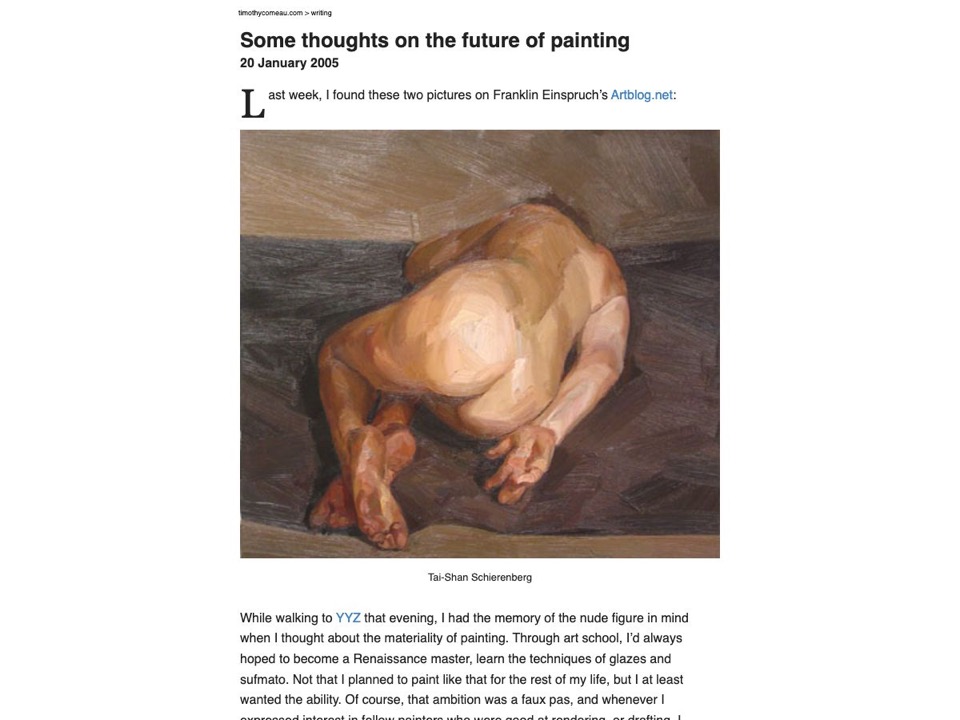
Paintings by Tai-Shan Schierenberg reopen a long-running argument about technique, imagery, and the physical presence of paint. Beginning with memories of art school and the wish to acquire Old Master skills, this essay questions the authority of twentieth-century artistic preferences. It broadens into a speculative account of generational change, digital technology, and the possibility that familiar conventions are giving way to a culture still learning how to describe itself.
Blogging
Shows on at Mercer Union, YYZ, and Paul Petro Jan 2005
Shows on at Mercer Union, YYZ, and Paul Petro (Jan 2005)
A January round of Toronto galleries restores some enthusiasm for art through work that changes the way familiar things are seen. BGL’s constructed environment at Mercer Union recalls childhood building projects, Elizabeth Belliveau’s transformed second-hand objects offer unexpected creatures, and C Magazine’s anniversary display at Paul Petro opens a local archive. The report connects material invention with memory, finding experiences that cannot be reduced to their publicity images.
BlogTo
Mercer Union's New Year's Eve Party Review Jan 2005
Mercer Union's New Year's Eve Party Review (Jan 2005)
Mercer Union’s “Dirtier” New Year’s Eve fundraiser becomes an account of how an art community invents ways to socialize. Following the history of Instant Coffee’s make-out spaces, Darren O’Donnell’s projects, and a bass-equipped bed, this review explains the relationships behind the party’s suggestive poster. Beneath the hungover report is an appreciation of settings that make affection, play, and encounters between strangers feel less awkward and more possible.
BlogTo
2004 Top Ten Art Related Things Dec 2004
2004 Top Ten Art Related Things (Dec 2004)
A personal top ten for 2004 gathers exhibitions, parties, a video, bookstores, and a changed opinion of OCAD’s new building. Submitted in response to Sally McKay’s invitation, the list preserves a compact record of memorable encounters with art. Its range suggests that the year’s cultural highlights were as likely to happen socially or in the street as inside a gallery.
BlogTo
The Queen West Scene, year in review Dec 2004
The Queen West Scene, year in review (Dec 2004)
A candid, explicitly personal review of Queen West in 2004 follows gallery moves, memorable exhibitions, parties, and the arrival of the Drake Hotel. The month-by-month account catches an arts neighbourhood negotiating new attention, new venues, and familiar tensions between bohemian life and fashionable consumption. It preserves the relationships and passing judgments of a scene whose changes were often easier to notice on foot than to summarize from outside.
BlogTo
Caught in the Act Book Launch Dec 2004
Caught in the Act Book Launch (Dec 2004)
An advance copy of Caught in the Act prompts a welcome for a book addressing gaps in Canadian art history. This launch notice introduces Tanya Mars and Johanna Householder’s anthology of performance art by Canadian women, drawing on Mars’s explanation of why documentation matters. It presents the publication as a way to make the achievements of the 1970s and 1980s available to students, artists, and future readers.
BlogTo
Vs at The Latvian House Dec 2004
Vs at The Latvian House (Dec 2004)
What happens when one video artist shoots the material and another takes control of the edit? This report from 640480’s Vs. screening at the Latvian House follows the resulting collaborations, clashes, jokes, and discomfort. It considers editing as both a creative power and a source of tension between artists, finding an evening that revealed as much about authorship and digital tools as about any individual finished video. A bit of trivia: this is the very first BlogTo article.
BlogTo
On turning 30 Sep 2004
On turning 30 (Sep 2004)
Approaching thirty alongside a friend born on the other side of the world, the author considers how age changes the stories people tell about themselves. Childhood memories, television, work, and the difficulty of achieving economic independence become ways to measure the distance between expected adulthood and lived experience. The essay broadens into a generational argument about inherited problems and the possibility that younger people might bring different assumptions to solving them.
Blogging
Trampoline Hall May 2004
Trampoline Hall (May 2004)
An evening at Trampoline Hall offers a model for a public talk that respects both speakers and listeners. Reviewing presentations on a family history, suicide statistics, and freeloading, this enthusiastic account contrasts the event with the exclusions and rambling performances of conventional panels. It celebrates the pleasure of a well-framed conversation: time to develop an idea, room for questions, and the sense that everyone present has something worth thinking about.
Instant Coffee Saturday Edition
The Sweater Song Mar 2004
The Sweater Song (Mar 2004)
A fictional future commentary introduces a recovered response to Weezer’s "Undone (The Sweater Song)". Moving between archival speculation, memories of 1994, and a more disenchanted life approaching thirty, the piece uses a familiar recording to hold together different versions of a self. Its imagined scholarly apparatus asks how much of an ordinary cultural experience might remain understandable after the music, its audience, and its context have disappeared.
Blogging
The International Space Station & Rex Harrington Dec 2003
The International Space Station & Rex Harrington (Dec 2003)
Two brief reviews contrast the quiet significance of watching the International Space Station cross the sky with the news attention given to Rex Harrington’s retirement. One finds an almost conceptual artwork in an actual technological achievement; the other questions the assumptions behind television arts coverage. Together they ask what deserves public wonder, what becomes culturally familiar, and how institutions decide which accomplishments are worth noticing.
Instant Coffee Saturday Edition
The Possessions Jul 2003
The Possessions (Jul 2003)
A. S. Byatt’s Possession and its film adaptation receive sharply different responses in this paired review. The novel’s literary investigation prompts reflections on reading as conversation, academic theory, and the reach of Byatt’s craft. The film, by contrast, is faulted for compressing the story until motives and discoveries seem to arrive without explanation. The comparison asks how much complexity an adaptation can discard before it stops feeling believable.
Instant Coffee Saturday Edition
HollyWood Inferno Jul 2003
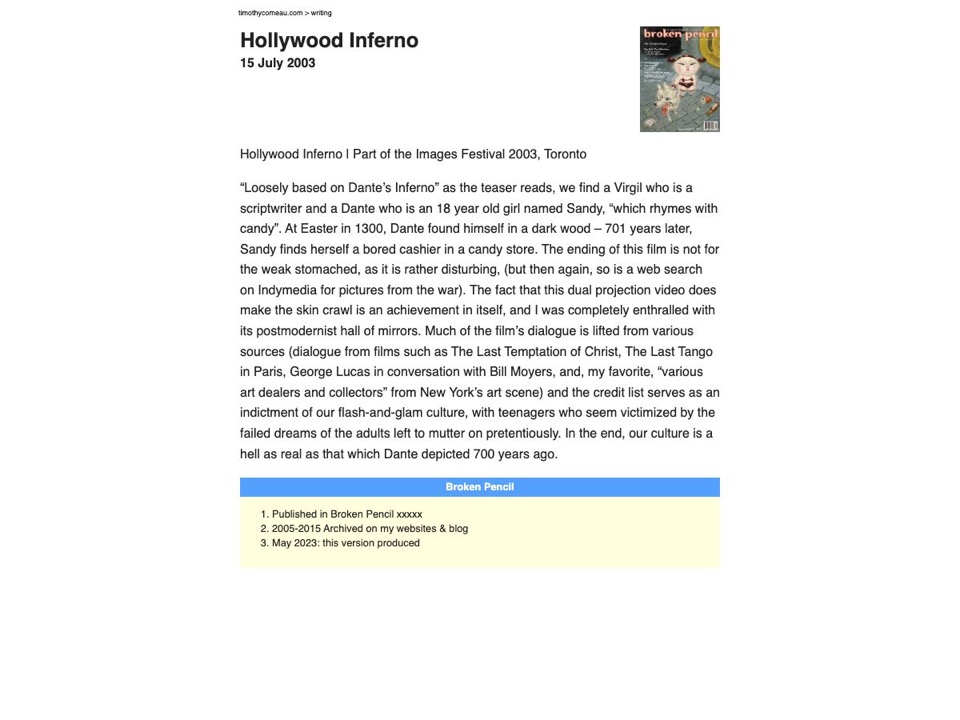
HollyWood Inferno (Jul 2003)
A dual-projection reworking of Dante’s Inferno turns Hollywood ambition into a disturbing contemporary underworld. This Images Festival review follows Sandy, a young cashier, through a film assembled partly from borrowed dialogue and the language of the art market. It praises the work’s unsettling force and reads its catalogue of cultural quotations as an indictment of glamour, failed adult dreams, and the young people caught inside them.
Broken Pencil
Videograms of a Revolutions Jul 2003
Videograms of a Revolutions (Jul 2003)
Harun Farocki’s Videograms of a Revolution makes the Romanian uprising of December 1989 visible through the television images bound up with it. This short Images Festival review reflects on the occupation of the broadcaster, the public experience of political change, and video’s ability to turn recent events into a historical record. It finds a reminder that democratic rights should not be taken for granted.
Broken Pencil
Tamala 2010 Jul 2003
Tamala 2010 (Jul 2003)
The animated film Tamala 2010 offers a strange encounter with consumer culture, cuteness, and Japan’s postwar economy. Reviewing its Images Festival screening, the author finds more to value in its oddness than the lukewarm reception suggests. Its mixture of graphic styles becomes a prompt to think about how unfamiliar films might look in the future, while recognizing that cultural distance can already produce that effect.
Broken Pencil
Unbalancing Act by Jo Cook Mar 2003
Unbalancing Act by Jo Cook (Mar 2003)
Jo Cook’s Unbalancing Act is appreciated as an elegant physical object as well as an open-ended narrative. This brief zine review notices the heavy colour-printed paper, the meeting of typography and handwriting, and drawings that suggest rather than explain. It considers the possibility of psychological disturbance or trauma without closing off the reader’s freedom to find another meaning.
Broken Pencil
Afield by Florentine Perro Mar 2003
Afield by Florentine Perro (Mar 2003)
Florentine Perro’s Afield combines careful construction with an elusive story involving ducks, bodily processes, and the lives of other creatures. This short review follows the booklet’s suggestive juxtapositions without insisting on a fixed interpretation. Its cardstock, colour copying, and abstract narrative invite consideration of emotional experience beyond the familiar limits of human and mammalian life.
Broken Pencil
September Eleventh’s Week in Review Feb 2003
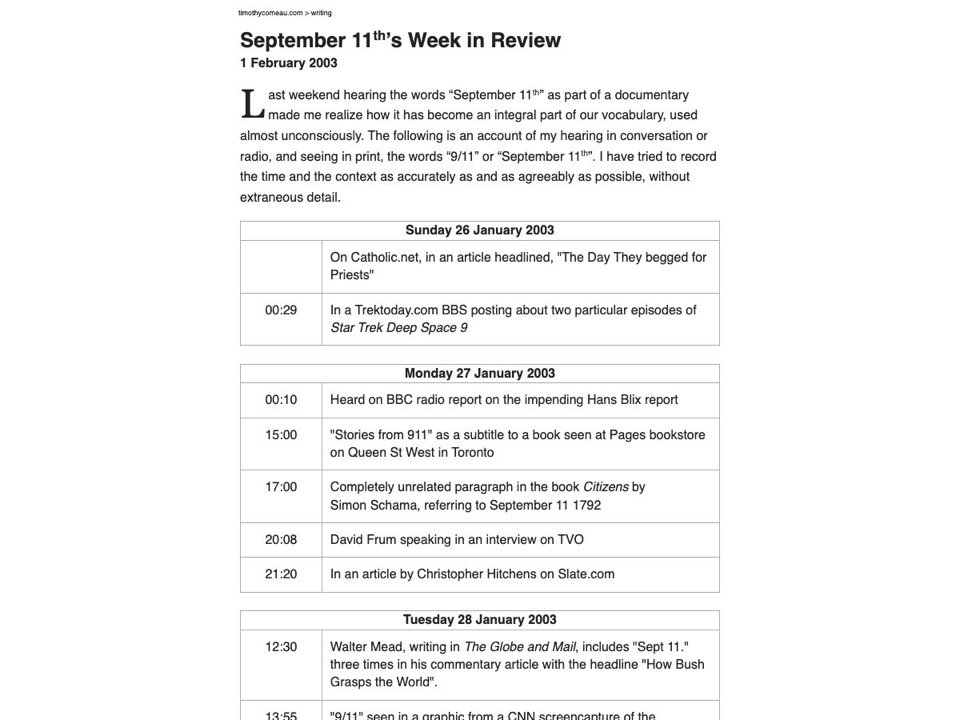
September Eleventh’s Week in Review (Feb 2003)
For one week in early 2003, the author records each encounter with the words “September 11th” or “9/11.” Broadcasts, newspaper headlines, websites, books, and conversation become entries in a timed log. Without an extended argument, the accumulation makes visible how a date had become a habitual reference point, linking discussions of politics, privacy, entertainment, and even a new space-shuttle disaster.
Instant Coffee Saturday Edition
The New Sobey's in Ajax Ontario Dec 2002
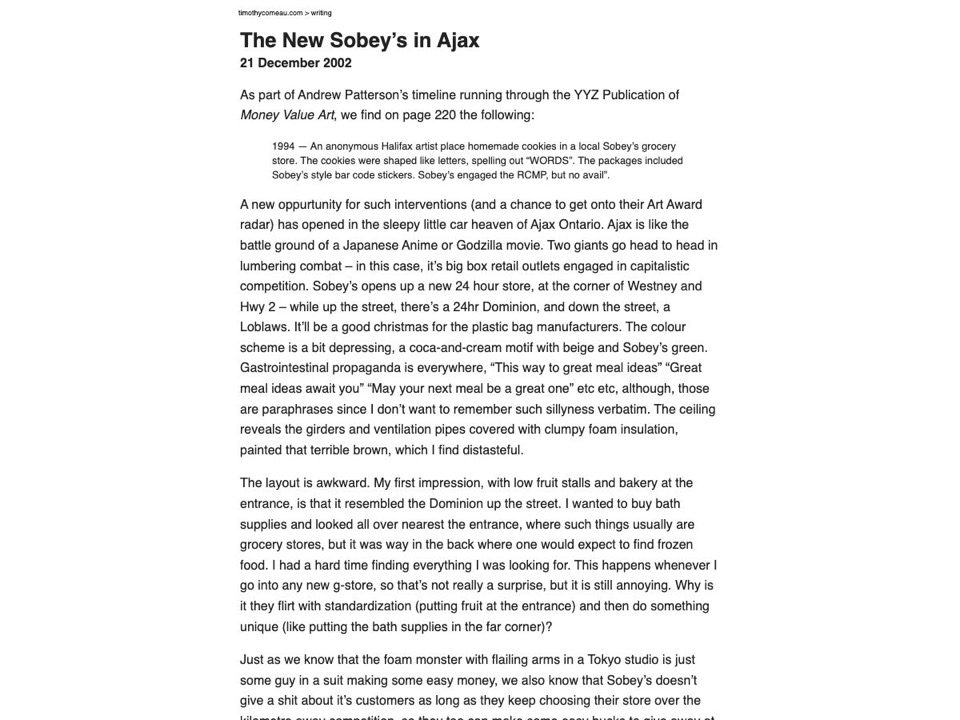
The New Sobey's in Ajax Ontario (Dec 2002)
A newly opened Sobey’s in Ajax receives the kind of close attention usually reserved for a gallery. This review considers the store’s colours, exposed ceiling, advertising language, layout, and checkout experience, setting everyday shopping against big-box competition and corporate arts sponsorship. It finds that promotional warmth does little to compensate for confusing organization, undertrained staff, and procedures that seem to matter more than customers.
Instant Coffee Saturday Edition
Letter to the Editor Oct 2002
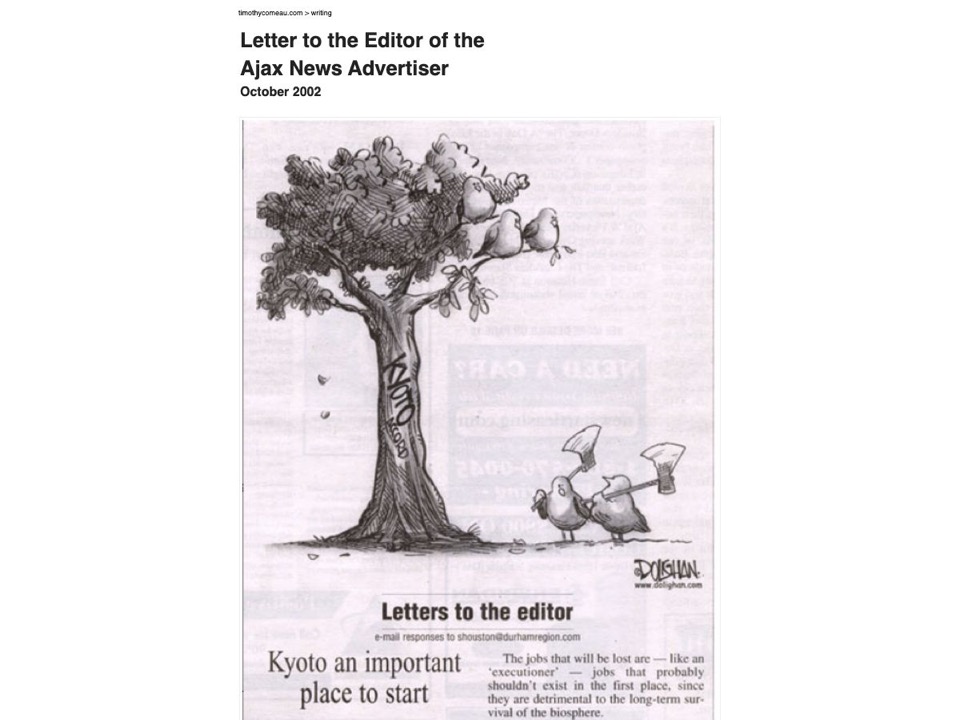
Letter to the Editor (Oct 2002)
A 2002 letter to the Ajax News Advertiser urges support for the Kyoto Accord. Writing as a young adult concerned about the world his generation is inheriting, the author challenges arguments that treat dependence on fossil fuels as economically unavoidable. The letter frames environmental action as an obligation to descendants and a source of new possibilities, even when an initial agreement represents only a modest beginning.
Blogging
Untitled Zine by James Whitman Oct 2002
Untitled Zine by James Whitman (Oct 2002)
An untitled booklet by James Whitman earns an enthusiastic response for its simple physical and visual pleasures. This brief review praises the solidity of cardstock and the freedom offered by abstract black-and-white line drawings without an explanatory text. The images recall contemporary graphic design while leaving the reader room to decide what, if anything, they represent.
Broken Pencil
Passenger and Tour Guides Oct 2002
Passenger and Tour Guides (Oct 2002)
Kevin Rodgers and Derek Sullivan’s Passenger & Tour Guides becomes an exhibition catalogue worth experiencing as an object. This appreciative review describes its flower-printed envelope, postcard-like images, fragments of handwriting, and folded map of an imaginary coastal city. Its layered packaging gives material form to the exhibition’s interest in romanticized views of the West Coast and the idea of a frontier seen from elsewhere.
Broken Pencil
Losercore Issue 1 & Older Man, Younger Woman Oct 2002
Losercore Issue 1 & Older Man, Younger Woman (Oct 2002)
Two zines by Maureen MacMillian approach love from opposite directions: rejection and regret in Losercore, happiness in Older Man Younger Woman. This review treats their familiar emotions sympathetically while finding particular pleasure in the second booklet’s retro imagery and cut-and-paste design. It considers the modest value of ordinary personal stories, even when neither their experiences nor their presentation claim to be groundbreaking.
Broken Pencil
Small Dead Woman Oct 2002
Small Dead Woman (Oct 2002)
An Artspeak catalogue pairing Kevin Yates’s sculpture with writing by Diana George and Charles Maude prompts reservations about both interpretation and design. This review questions the effort to build metaphorical meaning around violence against sex workers, while appreciating the publication’s unusual file-folder appearance. Its awkward handling raises a second question: when an art object invites participation, do gallery habits make readers reluctant to use it as intended?
Broken Pencil
Booker Prize Covers Oct 2002
Booker Prize Covers (Oct 2002)
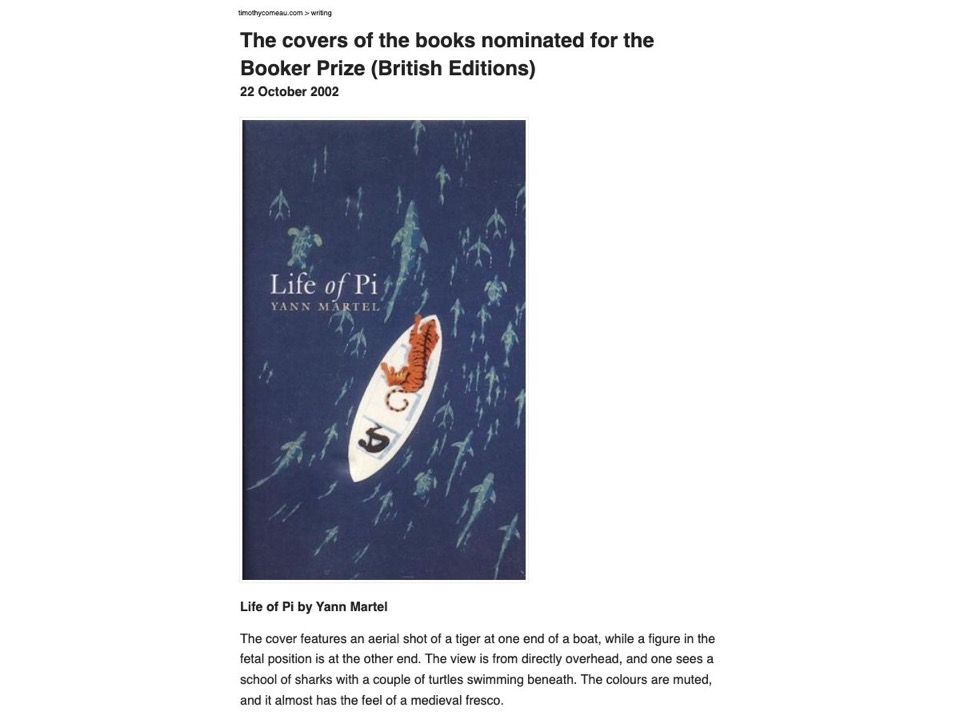
The British covers of the 2002 Booker Prize nominees are judged as designs rather than as guides to the novels inside. Looking at images, typography, colour, and the expectations each jacket creates, this piece makes its own visual shortlist. Personal preferences remain part of the argument: although Life of Pi won the literary prize, Family Matters is the cover that most successfully invites this reader to pick up a book.
Instant Coffee Saturday Edition
The Pope's Downsview Park Mass Sep 2002
The Pope's Downsview Park Mass (Sep 2002)
Attending Pope John Paul II’s Downsview Park Mass produces a mixture of personal awe and irritation with the surrounding spectacle. This account follows the early journey, rain, music, crowds, and the brief experience of seeing a historically significant figure in person. Its deliberately divided judgment distinguishes a memorable emotional encounter from reservations about public piety, Catholic teaching, and the disruptions of the larger event.
Instant Coffee Saturday Edition
Heironymus Bush by James Turek Jul 2002
Heironymus Bush by James Turek (Jul 2002)
James Turek’s comic Heironymus Bush turns the American presidency into a grotesque farce. This short review appreciates the way absurdity briefly gives way to reflection, finding a Beckett-like pause amid the violence and jokes. It also unpacks the title’s suggestions of inheritance, anonymity, and Hieronymus Bosch, reading the comic as one artist’s response to the frustrations of living under George W. Bush.
Broken Pencil
Interview Review of Atanarjuat May 2002
Interview Review of Atanarjuat (May 2002)
Having not yet seen Atanarjuat, the author asks Jon Sasaki and Sasha Havlik to review it through a playful question-and-answer exchange. Their replies cover subtitles, landscape, mythology, cinematic technique, and the film’s relationship to gallery video and Hollywood. The result is less a conventional verdict than a conversation about the expectations surrounding an Inuit-language epic and the ways audiences try to place an unfamiliar film.
Instant Coffee Saturday Edition
Cremaster 1 & 4 May 2002
Cremaster 1 & 4 (May 2002)
Matthew Barney’s Cremaster 1 and 4 receive irreverent readings after an Images Festival screening at the Bloor Cinema. Imagined James Bond plots, bodily symbolism, and the films’ sculptural slowness become ways to respond to their elaborate ambiguity. The review questions whether exclusivity and reputation do some of the work of sustaining their appeal, finding the shared anticipation of a scarce screening more compelling than the films themselves.
Instant Coffee Saturday Edition
Trudeau (TV Movie) Apr 2002
Trudeau (TV Movie) (Apr 2002)
CBC’s Trudeau is reviewed through Colm Feore’s performance, recognizable Halifax locations, and the production’s visual choices. The author appreciates moments that depart from the slickness of a conventional biopic, while noting the distractions created by familiar scenery. Most satisfying is the final use of archival footage, which reconnects the dramatization with the actual politician and makes the distance between the recreated period and the present more tangible.
Blogging
Takashi Murakami Lecture Review Apr 2002
Takashi Murakami Lecture Review (Apr 2002)
Takashi Murakami’s 2002 Harbourfront lecture combines a prepared account of anime with videos of his studio and new work. This report considers the effectiveness of those moving images, the juxtaposition of a Japanese festival song with September 11 footage, and the artist’s explanation of that contrast. The evening ends with autographs and drawings, making the connections between pop culture, factory production, and art-world celebrity visible in the room itself.
Instant Coffee Saturday Edition
Jessica Rowland's Distilled Mar 2002
Jessica Rowland's Distilled (Mar 2002)
Jessica Rowland’s Distilled prompts a reflection on the relationship between material forms and the ideas they carry. Moving from the remembered life of organic materials to Thomas Aquinas’s account of an experience beyond words, this short essay considers the limits of verbal explanation. It finds in Rowland’s work a more direct way of addressing what language can suggest but may never fully convey.
Blogging
Week in Review Jan 2002
Week in Review (Jan 2002)
A week in January 2002 unfolds through reading Borges, watching television, cooking, correspondence, job applications, and a trip into Toronto to volunteer at Mercer Union. These diary entries place cultural discoveries alongside errands, missed plans, and remembered dreams. Rather than separating artistic life from ordinary routines, the account shows them sharing the same days, with moments of creative excitement interrupting a quieter period of waiting and looking for work.
Instant Coffee Saturday Edition
Gallery Going 2001 Jan 2002
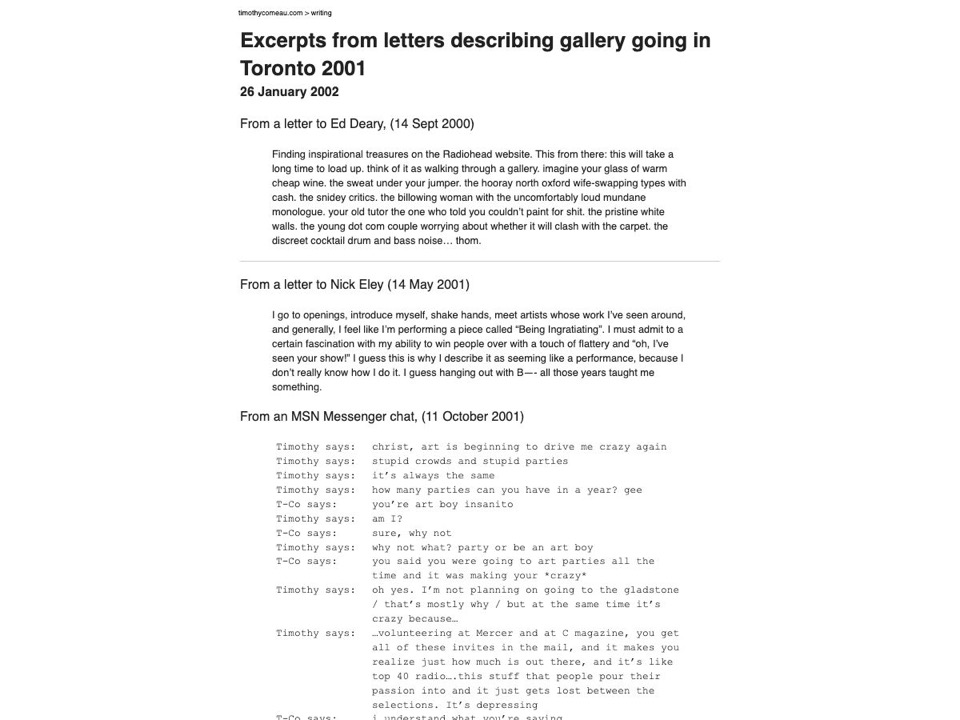
Gallery Going 2001 (Jan 2002)
Excerpts from letters and an MSN conversation record the attractions and fatigue of Toronto gallery-going around 2001. Openings become a mixture of curiosity, habitual attendance, social performance, and frustration at how much creative work passes unnoticed. The informal exchanges preserve the ambivalence of participating in an art scene: wanting conversation and discovery while growing tired of the repetition, drinking, and pretence.
Instant Coffee Saturday Edition
Lights On Lights Off Sucks Dec 2001
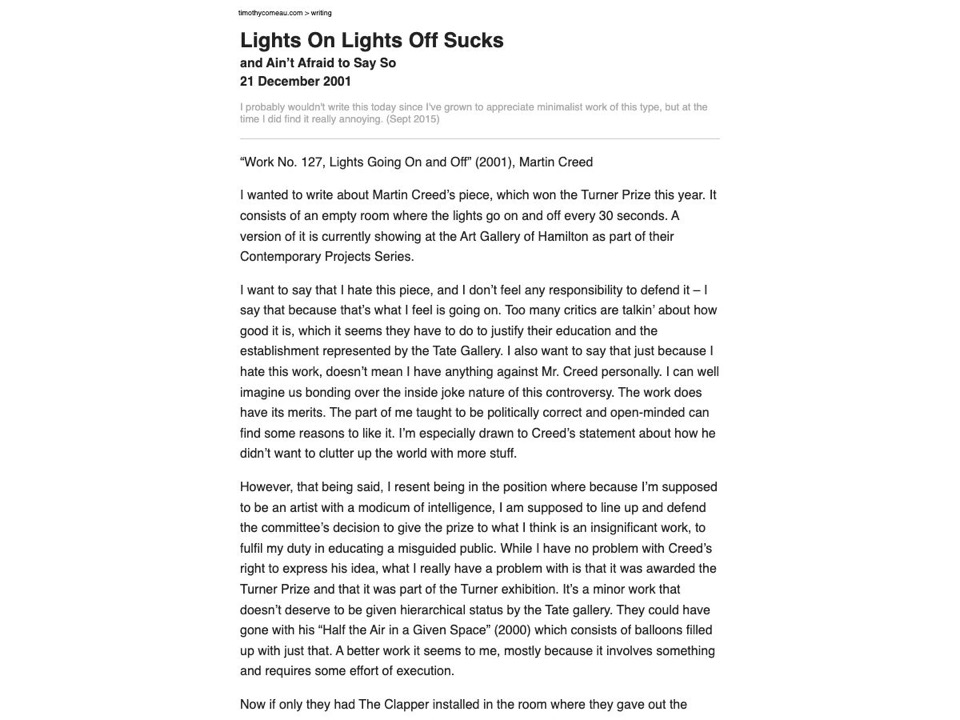
Lights On Lights Off Sucks (Dec 2001)
Martin Creed’s Turner Prize-winning room with lights switching on and off provokes an emphatic response. This 2001 polemic acknowledges possible merits but challenges the ease with which an institutionally endorsed work can be defended, celebrated, and made controversial. A later note records a changed appreciation of minimalism, leaving the original argument as a document of an earlier position rather than pretending the author’s taste remained fixed.
Instant Coffee Saturday Edition
Found on the Floor of the Go Train Nov 2001
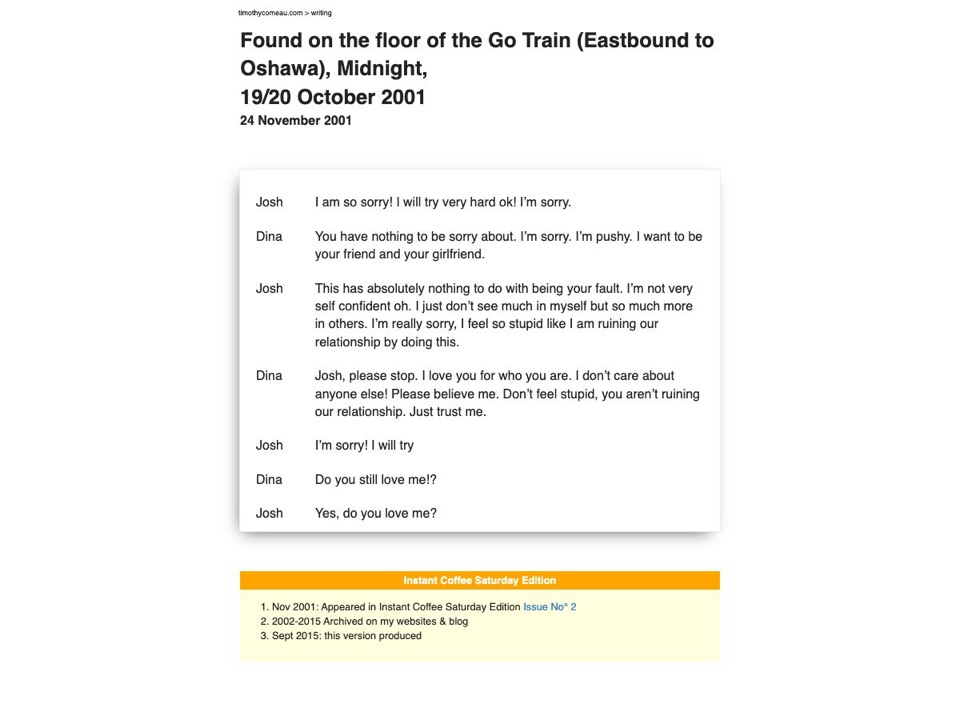
Found on the Floor of the Go Train (Nov 2001)
A written exchange found on a late-night GO Train captures two people trying to reassure one another about their relationship. Presented as dialogue, the recovered note moves through apologies, insecurity, affection, and an unanswered request for reassurance. Its ordinary, unfinished intimacy becomes a small piece of found literature, preserved without a larger story to explain who the speakers were or what happened next.
Instant Coffee Saturday Edition
Lecture Reviews Oct 2001
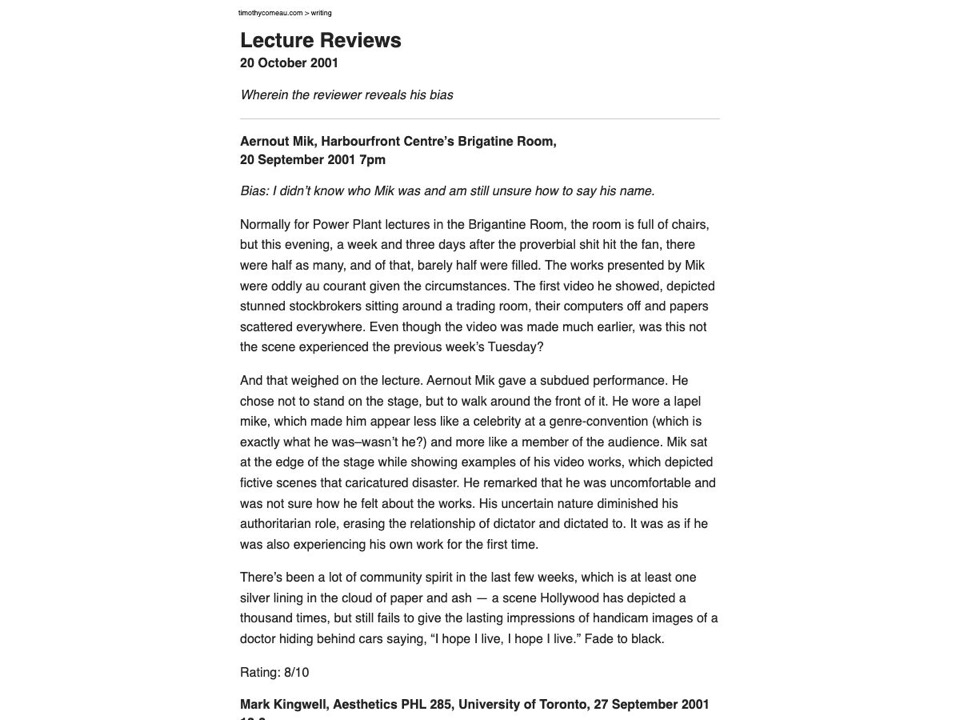
Lecture Reviews (Oct 2001)
Two September 2001 lectures are reviewed with the author’s biases stated at the outset. Aernout Mik’s disaster-like video scenes acquire an unsettling immediacy after the attacks in New York, while Mark Kingwell’s class makes Kant and Descartes feel relevant through confident teaching and contemporary examples. The comparison considers performance, audience, and setting as part of how ideas become—or fail to become—a meaningful shared experience.
Instant Coffee Saturday Edition
Parks Canada or the Technonaissance? Jun 2001
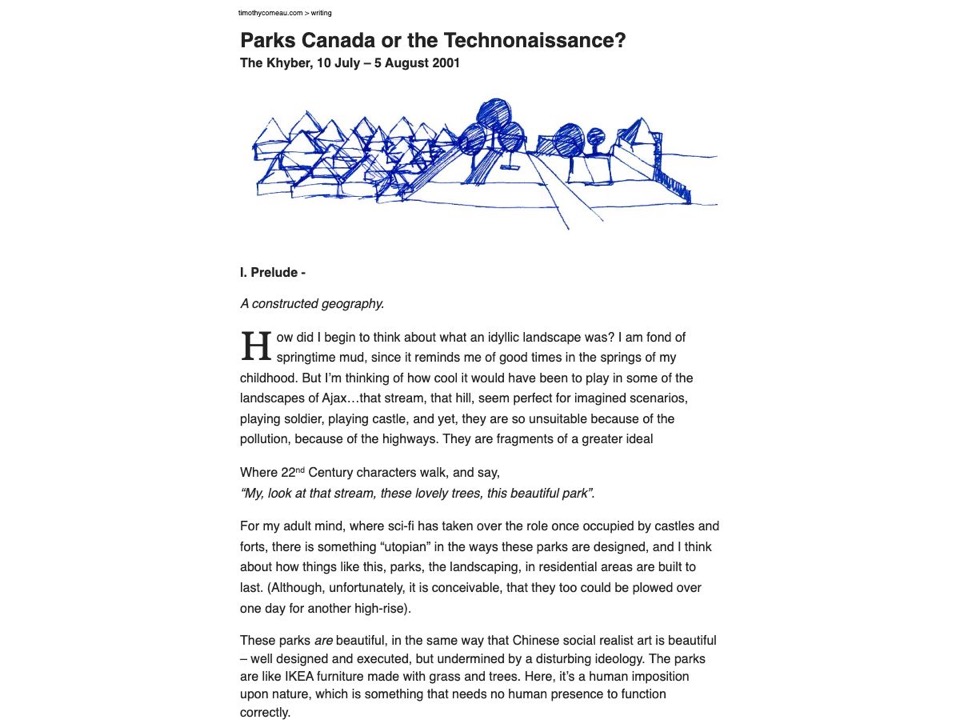
Parks Canada or the Technonaissance? (Jun 2001)
Written for an exhibition at Halifax’s Khyber, this essay imagines contemporary suburbia as a future historical recreation. Memories of Nova Scotia heritage sites, Renaissance art, and science fiction shape a new way of looking at Ajax’s parks, roads, houses, and consumer culture. Calling the period a “technonaissance,” it asks how a later society might recognize the aesthetic character of our technological beginnings while judging the environmental and social choices made around them.
Blogging
Thoughts on the future Sep 2000
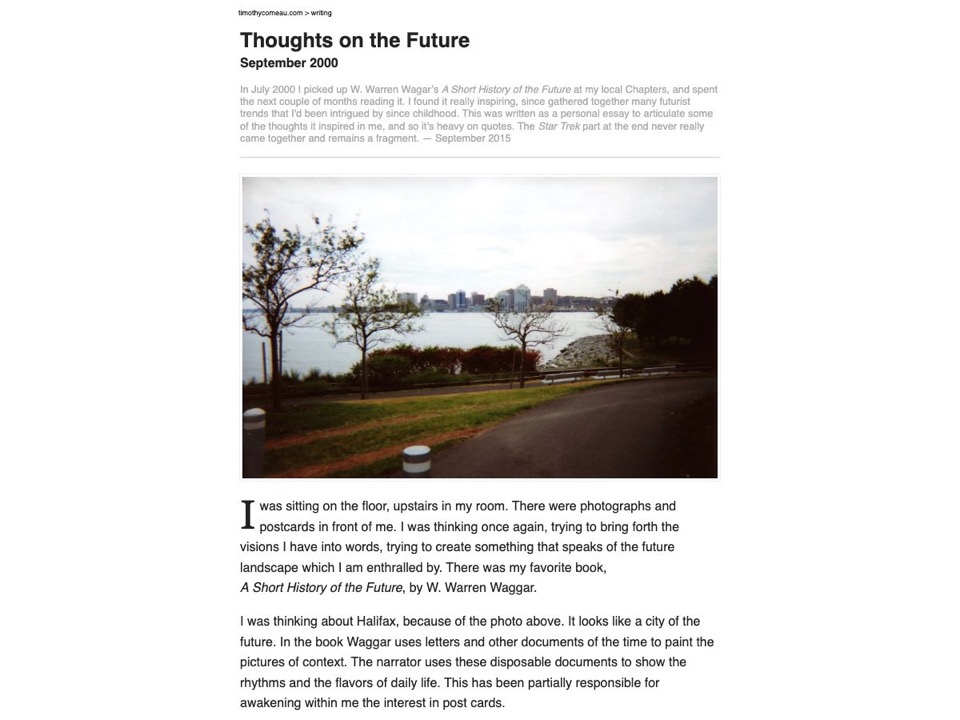
Thoughts on the future (Sep 2000)
W. Warren Wagar’s A Short History of the Future inspires an extended, quotation-rich meditation on the shape of a desirable future. Moving between Halifax, contemporary art, imagined communities, Tuscan life, environmental restoration, and Star Trek, this early essay asks what technological progress is ultimately for. Letters, images, and speculative histories become materials for imagining everyday life beyond consumerism, where advanced tools might support beauty, community, and a more generous quality of life.
Blogging
Nos Nov 1996
Nos (Nov 1996)
Written in 1996, Nos is a sprawling meditation on alienation, memory, and what it meant to be human at the end of the twentieth century. Drawing on the prophetic voices of T. S. Eliot and Allen Ginsberg, the poem moves between personal memories, consumer culture, mass media, and the accelerating pace of technological change. Haunted by nostalgia and the loss of historical continuity, it explores the experience of being uprooted from the past while swept toward an uncertain future, searching for meaning in a world increasingly disconnected from its own humanity.
Blogging
No writing matches your search.