
Collections of Care
The forms we inhabit are inheritances of things once cared for
For over a decade I’ve invested in a personal ritual of ending the work week with a few hours spent in a local bar, something I had mixed feelings about before 2020 and felt compelled to do after the lockdowns, whether I wanted to go out or not. Three beers, three hours, Saturdays optional. It’s an act of self-care because otherwise I spend too much time alone.
My current favourite is a spot whose playlist skews heavily Gen X (partially because one of the bartenders is my age) and so I can sit and think and reminisce about the younger days of the 1990s. Recently, my mind was cast back to the 1980s when Iron Maiden’s ‘Number of the Beast’ came on, without the Vincent Price intro1. I was first exposed to the Vincent Price monologue while passing notes in class when my friend and I were trading quotes. I wrote down some of Churchill’s wartime speeches, fight on the beaches and all that. My friend wrote down the intro to ‘Number of the Beast’. Hearing it now means it’s layered with memories of that friend and seeing his words on ruled Hilroy paper at École Secondaire de Clare circa 1992.
Iron Maiden also brings me back over forty years to the time when they were popular with my classmates, who drew Eddie on their ruled loose leafs, along with the Iron Maiden logotype. Were they listening to the lessons or drawing dicks and heavy metal logos in their notebooks? I look up Iron Maiden now on my subscription music service and see the album I got in 1986, Somewhere in Time. It introduced me to the story of Alexander the Great. I got it for Christmas because I wanted to understand why my classmates loved them so much. But I was 11 in 1986! I now have an 11-year-old nephew and can’t imagine him asking for a heavy metal record for Christmas.
When I listen to the song now, I marvel at how it opens, sounding like it answers the question, what if Saint John the Apostle wrote a song about his vision of the apocalypse during his exile on Patmos? Steve Harris gave us one answer. There may be more before the apocalypse arrives and Mary is seen crushing a snake beneath her feet on a cloud.
Saint John was the beloved apostle and the only one to not be executed, instead dying of old age. He took care of Mary until she was Assumed. He became a living link to the Patristic Fathers through Polycarp and Irenaeus. Polycarp was martyred in Smyrna’s amphitheatre on February 23rd 155, the date on which my grandfather died 1831 years later, the same year I got the Iron Maiden album. On the tenth anniversary of my grandfather’s death, I was at a house party and was caught in a photograph sharing a cigarette and looked as glamorous as David Bowie. God I was beautiful.
Through St. Jerome we get the story that in his extreme old age John was too weak to speak. The Son of Thunder had been reduced to a whisper, and constantly said ‘Children, love one another’. When asked why he constantly said this (to the annoyance of the congregation of Ephesus) he managed to explain it was because it was Jesus’ command and alone it was enough2.
*
On the second of January I walked the galleries of the AGO’s fifth floor and saw work I wouldn’t pay attention to at a flea market. But because it was created by a legend it had been preserved in all its mid-twentieth century adequacy. It was conventional work from the time, typical, unoriginal and uninspired. But it had been created by a legendary figure and what does that even mean? It means that they’d been talked about, gossiped about, and remembered. As I walked from one wall to the next, I saw the work begin to get interesting. There were some glimmers. And near the end, other names appeared as the manufacturers of the objects that had been commissioned by the legendary artist, a woman who lived on Queen St East almost next door to the place where two other legends partied in the early 1970s. She died of early onset Alzheimer’s at the end of the 1990s and now there’s a plaque on her old house.
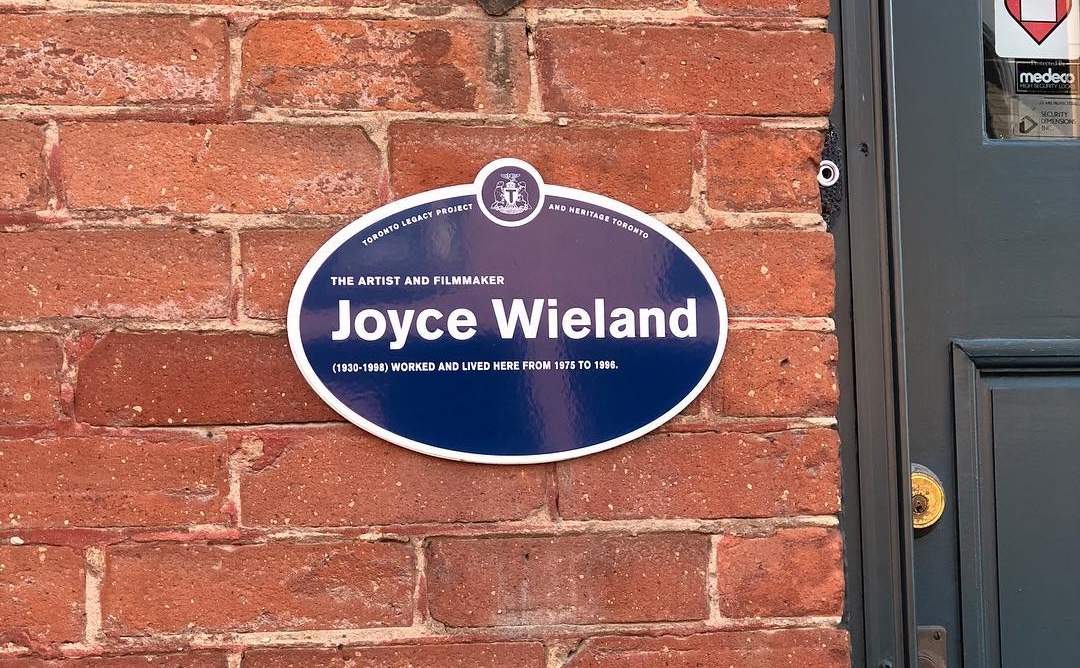
When I first read the plaque, I saw the dates that she’d lived there correspond to the first quarter of my life. I had grown from a baby to art school during a time that for her would probably have been a generic twenty years until the illness and decline. I’ve been in my current place for eighteen years so someone who was born when I moved in will be attending university this autumn. For me it’s been a generic twenty years. The house at 505 Queen East was where Dan Aykroyd and John Belushi first met and conceived the Blues Brothers and, in a sense and by extension, Saturday Night Live. When I began watching that show in 1990 it had a 15th anniversary watermark on the broadcasts.
Five months later I walked through the same galleries to see generic 1960s photos blown up and beautifully framed because they were those of another legend. These weren’t pictures you would linger on at a flea market except! These were photos from the time when rock and roll bands were a novel human experience, as were more portable and pedestrian 35mm SLR cameras. So here is a photo of nascent paparazzi running toward the car in a Manhattan street, as seen through the back window.
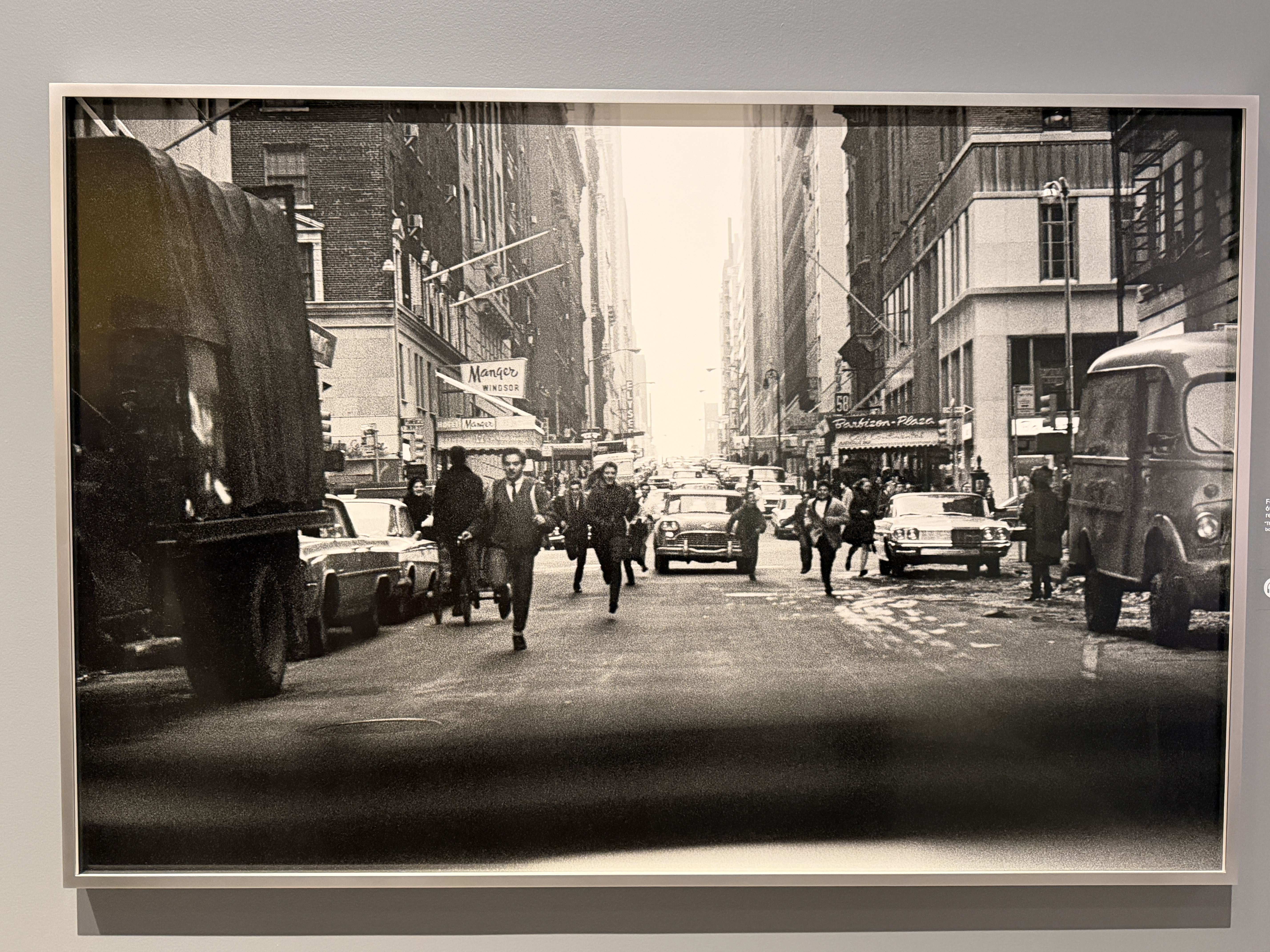
And there was a video in a side room showing the photographic printmaker working on a spot with a brush, reminding us that professional photos have always been an enterprise of manipulation and retouching even before the now forty-year-old Photoshop software.
The photos remain interesting as historical fragments but otherwise uncompelling as images. Recording the world eleven years before I existed, they help me understand and glimpse something of the continuity I was born into. They’re images by a Beatle at the centre of a cultural psychosis that functioned as an inheritance to my generation.
The image of the running photographers photographed captures the fact that they were trying to get their own grayscale images recorded with a lens and vanishing point perspective. If we zoomed above the scene, we could imagine the flashing triangles of competing vanishing points popping into existence like zero-point energy black holes. Pop pop pop pop like bubbles in a Coca-Cola.
Thirty years later I was in an Introduction to Studio Practice class which I’d marginally pass (resulting in academic probation). The TA, an MFA student from Montreal, explained how she didn’t like perspective and I was flabbergasted. How could someone be put off by a drawing technique? The argument I understood to be that that vanishing point perspective imposed a point of view. Even thirty years ago there were obnoxious people complaining about how they didn’t consent to that point of view. “It’s visual colonialism!” would be what we’d hear today.
It is said that the church is a hospital for sinners and so you shouldn’t expect to see only saints. Similarly, one does not go into an art school expecting to see cultural brilliance when it is a dumping ground for social misfits and outcasts, who maybe will make something that one day catches fire. For every John Lennon and Paul McCartney there’s a Joyce Wieland whose storage unit show hung on the same walls five months before.
*
In May 1504 Michelangelo’s David was wheeled out of the studio where it was carved. The president of the Florentine city-state Piero Soderini commented he thought the nose was too big, so Michelangelo palmed a handful of marble dust as he climbed the scaffolding up to the nose and tapped it gently with the chisel, letting the dust fall as Soderini watched, appearing to make an adjustment. When Michelangelo asked if that was better, Soderini replied that he’d made it come alive. Reported by Buonarroti’s first biographer Vasari, this story has informed my work as a digital craftsman for years. “Thus Michelangelo climbed down,” Vasari concludes, “and having contented this lord, he laughed to himself, feeling compassion for those who, in order to make it appear that they understand, do not realize what they are saying”.
Let’s increase the line spacing of this email that recipients will think of as spam.
Thirteen years ago, I was asked if I believed in past lives because an ex-girlfriend told me she associated me with sailors and the oceans, and that I made her think of Hemingway. It was meant as a compliment on my apparent masculinity. I was only 38 without any salt in my beard, and yet now my beard is quite salted. Three days to the 40th anniversary of the death of my grandfather on the Feast of St Polycarp, I was at the bar as usual only this time when I followed a couple out the door I was asked, “You’re not Mandy Patinkin are you?” I’d heard that I resembled him before, so it wasn’t novel, but being asked if I was him felt a bit insulting. My god do I look twenty years older? I’ve also heard that I look like Stephen Root and Seth Rogen.
I remember the Hemingway comparison as I sit beneath his photo at a bar down the street called the Done Right Inn which I’m told started on Dunn Avenue. Such histories tend to be unrecorded; I learned it through conversation and as such it’s unverifiable3. Thirteen years ago, I probably sat at this table (or the one behind me) when I was on a date with another girl from The Beaches who’d survived cancer and who I never saw again. My grandmother had just turned 100. For some reason I became pre-occupied with the mystery of being alive. How is it, I asked myself, that I won’t exist one day and won’t even know I was ever alive? What is this bubble of consciousness popping into existence and capturing its own point of view?
Our lives are entanglements, warping strands of the universe into thoughts that dissipate at death into a scattering of dust and into a shimmer of remembrance. As I entered my 40s the mystery of simply being alive led me to understand atheists were like the deaf complaining about classical music.
She told me thirteen years ago I reminded her of Hemingway and now we’re dead to each other. In the Done Right Inn photo, he is seen at a bar enjoying a drink with his bros. He was photographed doing so because the culture used to read. A hundred years later we’re in an illiterate attention economy that demands performance. Photos at bars are staged in between sponsorships.
There’s a boy who has named himself after a collarbone and he’s famous for hitting himself in the face with a hammer as if he were a Michelangelo sculpting his own flesh into a David. A sculpture doesn’t age because it is lifeless rock given the shape of a human, and may potentially outlast the species. Clavicular is supposed to age and die. Yet I have a horrifying vision that the life-extension technologies will work out and vampirically lock him into his 20-something state for the next three hundred years. Otherwise, I’d look forward to his existential crisis live-streamed as he gets fat and bald like every other generation of humanity. Meanwhile, in my fat and bald era I exhibit the masculinity of a stout Hemingway and the fat and bearded actors of TV and film. It leaves me feeling invisible to women or skeptical of their attention, thinking I’m being set up for a social media humiliation video.
*
Apparently, the kids think of the 1990s as a monoculture now when they watch Friends on Netflix. Those who didn’t live through a time learn about it through documentaries or the like and so get a point of view that serves the document’s thesis. When I was living through the 1990s we believed the 1950s had been a monoculture because it had been the era of Time and Life magazines. Jackson Pollock, we were told, could only have become as famous as he did because of Clement Greenberg’s review in Life4. Our own experience of the 1990s was already fragmentary, electronic and “post-modern”. A time of satellite cable television and dial-up internet. Meanwhile, we were reading Artforum which had Matthew Barney on the cover. Magazines felt central to culture and they’ve effectively gone away while remaining for sale at greatly diminished newsstands.
Last December I picked up the Artforum on display in a newsstand I used to walk through all the time, recognizing a name on the cover as someone I went to NSCAD with. They have since transitioned and their embodiment is now their content, their transformed body central to their artwork. Five hundred years after Michelangelo, performance artists sculpt their own flesh while influencers hit themselves in the face with hammers. I remember the person they were when they were a she and she was so attractive my personal nickname for her was Yum Yum. “Saw Yum Yum at the library,” I’d note in my journal. She epitomized feminine beauty in the 1990s and dated the equivalent of the cool jocks of our misfit academy. Thirty years later her transitioned name is on the cover of a magazine, a forgotten form recording her transform.
*
The prices for meat have doubled this year and if I’m now expected to pay that much it should at least look fresh. Instead, I’ve seen a grey pallor under shrink wrap. I’ve also stopped buying fish at one local grocery store because it also looks terrible and I’ve had two incidents of salmon being off when I’ve opened it. In both cases I’ve gotten a refund, and the second time I was told I should return the rotten fillet to the store. What am I supposed to do, I asked, freeze it first? The answer was yes, but I got the refund anyway without delivering a rotten frozen fish package. There’s another grocery store where I went to pick up a specific brand of pork loin and to my disgust found all the ones on the shelves had expired eight days before. I was so appalled I asked to speak to the manager. When he showed up, I was dismayed by his appearance. I pointed out they were offering expired meat, and I watched him collect them all while I changed my plans for dinner. Both meat department guys looked like shit. Both were signalling that the carelessness of their appearance is being extended to the food they are managing. If you’re looking for grey meat sold by slobs, I know where to send you. You want the places you buy food to look cared for, and you want the people who sell it to you to look like they take care of themselves.
I also had a problem last autumn where I was often waved at by the person at the lotto counter while I waited patiently for the conveyor-aisle. I’d always say no. One time no proper aisles were open, and I asked the lotto attendant if she could open one instead, and she did so. I explained that these aisles have a bagging area, and that I find paying at the lotto counter offensive, as well as the self-checkout kiosks. “There are four aisles here, and only one is ever open, and there’s no place to bag there,” I said pointing to the lotto counter, “or there,” pointing to the kiosks. Eventually all four were closed one day and there was a line-up of carts at the lotto counter. I was outraged and wrote an angry email to the manager. What the fuck were they doing? Why was the store being run in a way hostile to the customer? Last weekend I tried to buy bottles of Coke from an assembled display but found the shelves had overhanging lips that prevented me from lifting the bottles off the shelf.
The world I was born into had bagging people but fifty years later everything has been cost-cut so we’re expected to do everything ourselves. Now we’re supposed to endure the indignity of not even having a surface to bag one’s purchases on.
I see it as evidence that people have stopped caring. We have a world of designed things meant to solve problems and they are being ignored. Solutions are inconvenient to implement or counter-productive to the immiseration that seems to be the desired goal. Fifty-seven years ago, in his Civilisation series Kenneth Clark diagnosed the fall of a civilisation to exhaustion, and I think we’re all sensitive to that right now. We see it when we leave our homes. People have stopped giving a shit and so everything is going to shit.
The city of Toronto is blessed with an island park that is a bit of nature restorative to the soul, and we only recently got a reprieve from the political philistines who want to ruin it with increased commerce and an expanded airport. These people do not seem to care.
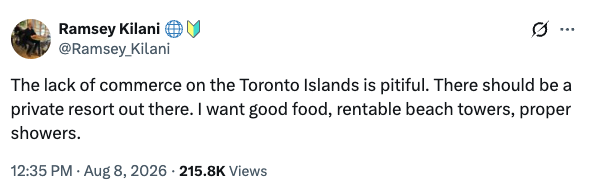
The islands have survived this long because they are cherished and appreciated and delightful, and so enough people filled out an online survey to scare off the development for now. (The cynical believe that had the airport expansion been approved, the governing Liberals would have lost an inner-city by-election). The philistines are now complaining the city isn’t ambitious, when it is clear to everyone who lives here that the ambition of the tasteless and stupid has already ruined the place enough and led to the logic of grey meats and lotto counter checkouts.
*
Who decided that grocery store aisles are obsolete? Who decided that the people who prepare our food can get away with looking unhygienic? The people who are supposed to be tending the gardens have quite literally outsourced that to exploited wage-slaves who poison the food with explosive diarrhea parasites5. Our complicated society is supposed to be managed but the managers seem to have stopped enforcing standards and signalling that our society still works. Who decided that care was obsolete? Obviously, no one. These are emergent conditions that result from an accumulation of apathy.
The result is this necrosis of falsity. We’re now lied to blatantly, because ‘who cares?’ We’re lied to by the media and our attention economy has produced a repellent superficiality.
Who is supposed to care? What prompts me to consider all of this is how culturally we’ve let the philistines build Potemkin Liberty Villages akin to plywood film sets. Facades without depth. A uniform used to be a visible signal of responsibility, and now managers don’t want to tell their butchers to wash their hair. The young now curate their costumes for an attention economy while they are careless with the truth, and everyone can read between the lines. The attention economy produces things meant to be looked at and neighbourhoods and restaurants that are meant for people to look good in. We have become very good at seeing things while being very bad at looking after them.
We live with a culture of fake gloss where forms of the past persist, but they aren’t being tended to. In the world of code, we speak of tech-debt where the accumulation of older work becomes burdensome and eventually it’s forgotten why a code block even exists. Is this obsolete or load bearing? Tending also implies pruning. The solution to tech-debt is deleting old code and rewriting things to be more efficient.
Luca Landucci recorded in his diary that it took four days for David to be moved from the studio and a further three weeks to get it fully installed. The place of installation had been decided by a committee that included Leonardo da Vinci. But what if the committee had instead decided it was too awful to look at? That instead it should be cancelled? What is the difference between censorship and curation?
Already I find my local TV news to be overly preoccupied with feel good lifestyle stories at the expense of news I could use. Editorial decisions are being made that prevent me from knowing more about the mismanagement of the provincial and municipal governments. The news media has been so devastated in recent years by who-gives-a-shit management decisions it is now harder to understand what is happening in the world. There’s a feeling that things are being censored and it’s obvious in many cases that we are being lied to. Social media fills in gaps of contemporary knowledge, but it too is irresponsible and dishonest, full of engagement bait falsehoods which people click on as they go uhn? and question their reality. We’re lied to by the media and by the appearance of things.
I walked into the favourite bar on a night in July after seeing Jack White phone in his White Stripes hits that nobody was allowed to film because our phones had been bagged. The bar was hosting an open mic night where the singer was yelling “I want to die! I want to die!” as he hit the acoustic chords with the force of 1990s grunge. Another person wearing the costume of Kurt Cobain.
I reflected that the bohemian form is like a spirit in the world that finds embodiment in every generation just like the spirits of masculinity and femininity. I’ve lived long enough to see how types of people are as constant as the seasons, forms of style finding new adherents in each generation. The academics are now obsessed with gender and identity and argue that people’s identities are chosen as consciously as shopping for a wardrobe but also as unconsciously as an artist intellectual turning into Hemingway. People can choose to dress like 1993 Kurt Cobain in 2026 just like people could choose to dress like 1970s Neil Young in 1993. And both decades contained bombshell blondes with a logo written across the ass of gym shorts, another type.
Identities are formed in youth in front of mirrors and shape the wardrobe choices of people who have not yet experienced the discombobulation of aging. The young who consider consent the ethical cornerstone will be forced into different bodies and different faces without consent and become unrecognizable to themselves as they molt like moths. Everyone speaks of gender affirming care, but we haven’t yet discovered the age affirming care that was sought by Ponce de Leon in the 16th century. I mean, Clavicular is promoting peptides though he may end up with fangs in his neck.
The attention economy focuses on youth and its naiveté, and it runs through the cameras of our phones. The mirrors of youth have become the selfies of Instagram and the videos of TikTok. Thousands of people right now are looking at their phone and talking to it thinking it a window to an imagined audience. Five hundred years ago such behaviour was either delusional or called prayer.
It’s as if Simone de Beauvoir’s explanation eighty years ago of how women internalized being looked at has grown to encompass all of us under a surveillance culture. We watch ourselves walk into stores on monitors above the doorway. The camera phones have exaggerated this social condition, and contemporary digital image culture is training us all to be as self-conscious as a 1940s French woman. And once the imagined spectator is given such prominence, things, bodies, places and experiences become tuned for the view seen by others rather than as experienced from within. But this seems generational: it seems irrelevant to people over the age of 45 and to butchers.
But ironically, in a surveillance culture that is so totalizing, it’s impossible to pay attention to everything. Everything is recorded while most of it is ignored. When the news reports on some crime, we get some out-of-focus piece of shit image and a generic suspect description. The police state doesn’t even fucking care. It’s all so absurd.
The grinding absurdity is what I find exhausting. It is sandpaper wearing down our souls and enabling the full-on fascist playbook of making us give up expecting the world to be rational, so the crimes become tolerable. Just like Hannah Arendt documented.
Close the checkout lines, make the TTC run unpredictably, bulldoze Ontario Place, expand the island airport, sell expired meat, rip up installed bike lanes and tell us it is to improve traffic while the street is closed for the excavators, take fifteen years to open a new train line while the new subway balloons to three times the estimated cost and its opening date is pushed back from 2027 to 2031 to indefinitely.
It’s grift and incompetence and malevolence and mismanagement and neglect. This absurdity is compounded by the fact that the fascists are too stupid to do this on purpose. Rather we get fascism as an emergent form because no one is minding the stores anymore.
*
Personally, I was raised with the modernist ethos that form should follow function and that in turn created a semiotic reading where the meaning of something was revealed by its look. It’s the source of the costumes the kids now wear. I recognize that would merely be an expression of my personal taste if I hadn’t already made the points about how the look of something shows us if it has been taken care of. I don’t like influencers or an attention economy when we’re being shown how the underlying expression is a lie.
It suggests that good form is the result of care and consideration, and that recognizing good form &emdash; having taste &emdash; is an awareness of the stories of care that informed it. The reason Joyce Wieland had a show thirty years after her death was because the institution not only cared about her objects but also the stories around them. A plaque ended up on Joyce Wieland’s old house because people did things there. The other legendary spaces of a community like bars and restaurants and concert halls are such because people lived and dwelt within them. Music was chosen, conversations were had, memories were made. The forms of these things are dense because they mediated reality.
Galleries curate, one of those borrowed from Latin words where curare means care. I still think about Heideggerian dwelling because I notice the word dwell is available to English speakers but is seldom used, while this essay is all about sorge. I summarize dwelling as being what life is supposed to be about: cozy afternoons, good meals, conversations with strangers in a bar, lying on the grass in a park, a summer concert under the stars. We haven’t yet lost those things even while the soulless managerial class of Heideggerian “technicity” thinks the parks are undeveloped condo lots and the island needs 900 metres of extension to land the jets of entouraged executives in their Escalades. We haven’t yet lost them but it’s questionable whether we are taking good enough care of them to ensure they won’t be.
As I mentioned earlier, curation sometimes means a decision to not show something. Include this, exclude that. Trim the fat or prune the plant, there is something in tending that requires a decision to nurture the best and eliminate that which doesn’t measure up. Taking care can sometimes mean destroying. The executives who wanted to destroy the island park would tell us they were trying to tend to the airport, but that doesn’t mean I agree with their choices, which I find vulgar, mean and stupid.
I’ve spoken for years about how one of the absurdities of our culture is how the museum functions as an institution where it is implied they are preserving things until the literal End of Time. Are we to take care of Joyce Wieland’s not yard-sale worthy art until Jesus returns to the soundtrack of Iron Maiden? The committees of the future will need to make editorial decisions as they tend the warehouses and the databases. What will happen when the culture gets full? What is the difference between preservation and hoarding? Do we honestly expect the Paul McCartney photographs to exist in 3026 and 4026 and 5026? And if not a thousand years from now, how about five hundred? And if not then, what about 2426, 2326, 2226 or a mere hundred years from now, 2126? This simple thought experiment suggests a future social reckoning that will signal the true exhaustion of our culture, which we are so far merely LARPing. We’re not exhausted in the Kenneth Clark sense, we’re just lazy. Managed decline could just as easily be replaced by managed flourishing if the managers began to give a fuck.
The editors would cut out the vulgarity of the above and that is part of the curatorial process. Like the documentaries that mislead the young into thinking the past was a monoculture, too fine an editing process can exclude the ambient reality of competing voices, stories, and things worth preserving. There’s a passage in Petronius’ Satyricon where the characters wander in an ancient art gallery, seeing masterpieces of the time which must have been destroyed later. (This was also depicted in Fellini’s film). The Satyricon dates to the lifetime of John the Apostle and was written by one of Nero’s courtiers. It is credible that Nero was the original anti-Christ to whom the Number of the Beast referred when John wrote The Revelation after his fever dream on Patmos6. The satire in turn written by the Anti-Christ’s secretary survived because Petronius wrote something vulgar and it preserved what more refined curators would have discarded.
I am now middle aged, and I walk through art galleries feeling dismissive of the legends of those who came before me. And that is how it’s supposed to be. Each generation inherits a world, but they also get to choose what they want to keep from it. When we hoard the past, are we allowing room for the future to make their own legends? Already my middle-aged peers are conversing amongst themselves about what to do with the stuff of their parents. I have seen more than one article about this already – parents who think their furniture is an heirloom and the children who don’t want it. A walk through any museum tells us it has always been this way; we don’t have 15th-century heirlooms in our condos. At some point the inheritance chain was broken. What strikes me about the past century is how we got rid of conventional domestic fires. Fireplaces and stoves used to provide every household with an incinerator, and so old clothes, newspapers, pamphlets etc., were reduced to ash, which made the things that survived from the deep past remarkable and irreplaceable. We in turn inherited a sense of the past’s fragility, which makes us want to preserve, even while we began to make things in indestructible materials. We’ve banned plastic straws because we’re afraid all this disposable plastic will last until the End of Time.
Death and destruction in their own way are important to the process of creating and recognizing value. We care for things and they survive, and sometimes things survive because no one cared enough to throw them away. The future will have a curatorial problem that we can barely imagine.
As much as aging is an insult it is also a different stage of a flower in bloom. Humanity has much practice at it, considering it’s been happening since The Beginning of Time. You’re supposed to become so frail that you’re carried into the congregation and barely able to speak. The extreme old age of St John the Apostle was probably that of his 90s, around the turn of the second century. We know this nineteen hundred years later because he was cared for and he helped create an institution of care out of the things he lived through with Jesus. He was one of those that taught others the replication of the Last Supper that we call The Mass. He laid his head on Jesus’ breast that evening and heard him take bread and wine and say that it was his body and blood, transforming the work of sunshine, rain, harvest and human hands into a sacrament that was taught to others. John disappeared into legend and mystique while Peter’s tomb became the altar of the Vatican. John’s destruction was also a most fruitful creation. The words at the end of his life, “children love one another, it is enough” echo to us as a reminder that taking care of each other and of the things that enable that is what we are supposed to do.

1. It turns out this is not by Vincent Price but by Barry Clayton imitating him because Price didn’t agree to do it.
2. St. Jerome’s Commentary on Galatians, chapter 6 verse 10; a version
3. I later met one of the founders of the Done Right Inn bar and was told this was untrue.
4. This is the compression of memory at work. The August 8 1959 Life article was written by Dorothy Seiberling but the lessons of the 1990s elevated Clement Greenberg’s role at making him household-name famous, primarily by promoting him to the point that Life magazine took notice.
5. The Summer 2026 Cyclosporiasis Outbreak
6. I’m taking the traditional biography of John seriously here; however, academic scholarship is divided on the true author of Revelation. The traditional biography of John is that during the reign of the emperor Domitian (81-96) he was sentenced to die and was immersed in boiling oil but unharmed. After this he was exiled to Patmos until after the death of Domitian. He settled in Ephesus during the reign of Trajan (98-117) and died around 100AD.
Record created on: 2026-08-23 • Modified on: 2026-08-25 / 2026-08-24 • Last edited on: 2026-08-25